/* */

Wednesday, July 02, 2008

Google Debunks Link Sabotage Theories

The search engine thinks the apocryphal talk about webmasters being able to wreck their competitors by creating bad links to them is just a bunch of talk.


Editor's Note: In summary, Google says it's not likely a bad link would hold as much weight as the quality of content on a site when determining search rankings. That's not a complete denial, however, that it couldn't happen in "borderline" situations. Have something to say about this? Say it in the comments section.

One webmaster who believes he has suffered at the hands of such "Googlebowling" tactics isn't convinced that Google looks closely enough at potential abuse coming from specially crafted inbound links.

At Search Engine Roundtable, the assertion exists that a little sneakiness by a webmaster will be the only item needed to build and target a rival, and drop it from Google's rankings. A post at Google Groups detailed how the targeted webmaster would experience such a sudden loss:

Create a bunch of links pointing toward of all your enemies and competitors' websites then use some really nasty Anchor text Keywords. Don't link the adult keywords to the site's main or index page, DO link the keywords to a single specific page on the site and use that same page as the only page to link the content too. Googlebowling works better if you embed the links into a video or flash (please note the example).

A Google staffer followed up on the post, claiming the site targeted by the Googlebowling ought to be looked at more closely, and in the context of Google's quality guildelines.

"Looking at the site that you mentioned, I could imagine that studying our Google Webmaster Guidelines, in particular the quality guidelines, would be time well spent," Google's John Mueller said.

Most of these guidelines involve the content on the site itself, something which generally can't be changed through links pointing to the site."

In a mildly direct way, Mueller suggested the site's low quality, not the inbound links, needs work. As far as evil linking and site rankings go, Mueller said in a follow-up that in theory the linking cited could cause a problem in some "borderline situations," but still suggested the webmaster in question needs to study Google's quality guidelines.


For Google,Every Day Could Be Super Bowl Sunday

Now that Google is a publicly traded company, traditions and advertiser friendly philosophies seem destined to clash with fiduciary responsibility. Imagine this scenario: Everybody uses Google, so every advertiser needs a presence there, and the law of supply and demand makes Google one expensive place to be.


Editor's Note: Google's rise in market share has been matched by a rise in stock prices. What happens when there's no more market share to grab? It's not far-fetched shareholders will pressure Google into monetizing wherever they can, at the advertiser's expense. Is inflation in our future, or will market or regulatory forces prevent? Please postulate in the comments.

Big companies were reluctant a few years back to shift a significant amount of their advertising budgets to search marketing. This reluctance made conditions perfect for small businesses to take advantage of Google's relevancy at bargain basement prices while Google built its reputation and search share.

But big companies wised up, making competition for ad space even fiercer. Those big budgets provided a big advantage in organic results, too. While bootstrappy, budget-conscious companies tweaked and tested and gamed to get better organic placement, large companies realized pretty fast it was easier just to buy a site already ranking for relevant keywords.

Trends like these, along with Google's own renewed focus on raising search ad real estate prices by reducing the number of ads while increasing relevancy for users and, by default, conversion rates for advertisers, mean Google was already headed for high-roller club status. And now Google is reaching into Yahoo's pot, too.

Effectively, Google has the potential to reach 90 percent or more of Internet searchers: 90 percent of the US, adding to 90 percent of the UK and Europe. That's what, a couple of hundred million searchers? Add that to other advertising roads Google is traveling—TV, radio, print, wireless—and remember how a 30-second spot during the Super Bowl grabs a couple of million dollars for the network broadcasting it.

Consider this also: According to ComScore Chairman Gian Fulgoni, Google has made its billions from just five percent of its ads being clicked. Not to insult your math ability, but that's 95 percent of Google ads that are not clicked. Though clicks are monetized based on direct action, Fulgoni says only 16 percent of ads have direct online effects; 21 percent have latent online effects, and 63 percent have latent offline effects.

"[S]o 84% of the value isn’t being monetized by search engines," Search Insider's David Berkowitz summarizes in his " Dreaming of a Super Model" report. The value in that 84 percent is in less tangible branding value. Enquiro attributes a 16 percent brand lift when the brand made an appearance in the top organic result and the top sponsored result.

Fulgoni used these numbers to suggest Google could maximize profit by adding a layer of cost to search advertising in the form of cost per impression. Either by display advertising (Google can certainly pull up DoubleClick's CPM expertise for this*), or by simply charging every time a text ad appears on the search results page, Google could up its ad revenue by huge margins. Advantage: advertisers with huge budgets, and Google shareholders. Disadvantage: Google goes back on its core philosophy of clean interface, simplicity, and equality of opportunity.

Think that can't happen? You could be right, but "fiduciary responsibility to shareholders" is a much weightier phrase than "advertisers will be outraged." Berkowitz joins a likely chorus that advertisers would break this model:

"So, what would a CPM model add to search? In this economy or any economy, not much. Yes, it would show marketers that there is more they should value. At the same time, that would make search marketing much less appealing. There are competing forces: the engines aren’t cashing in as well as they could be, but marketers have enough pricing concerns with search even when they’re getting a great return on investment, let alone when they’re struggling."

Making Your Email Experience More Enjoyable

I recently searched through the mozilla thunderbird extensions website and found 4 extensions that I didn't know about that actually prove to be quite useful.

I use Thunderbird 2.0.0.12 on Foresight Linux and have tested all of these extensions and verified that they work on that environment. Hopefully, they'll help someone craft a more enjoyable email experience.


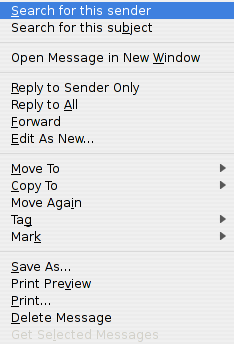
Search for Sender - If you're like me, you like to group like items together in your inbox. With this extension, you can group emails from the same sender as quickly as a right click. Really, it's just a shortcut that places the sender email up into the search box and searches for you. The nice part is, with this extension, you don't have to type it. Quick, easy, and simple. This has quickly become an extension that I cannot live without.

SyncMab - SyncMab is an extension similar to foxmarks for Firefox. With foxmarks, you keep all your bookmarks on a central server of your choosing so that your bookmarks are the same across all computers you use that have Firefox installed. This is perfect for me since I have a set of work bookmarks and home bookmarks and like to be able to switch back and forth between them. But what about thunderbird? It doesn't have bookmarks right? Exactly, but it does have contacts in your addressbook! So, you'll be able to save your contacts to a server of your choosing and then on another computer with thunderbird you can synchronize your contacts by downloading that file using SyncMab. It's brilliant and allows you to always have the same contacts across operating systems, across computers, and even to maintain multiple addressbooks.

Display Quota - This extension will display a small graphic in Thunderbird that tells you how much space you have left in your IMAP mail account and can warn you when you get close to filling up. This might not be too useful for those of you that use IMAP with huge quotas (gmail) but for others, it may be. I have heard that some users do not like the popup that displays for warning on this extension. For those users, Thunderbird has a built in function you can enable:

Open your configuration editor in Thunderbird and find the following keys:

1. mail.quota.mainwindow_threshold.show - % when quota should show up

2. mail.quota.mainwindow_threshold.warning - % when quota becomes yellow

3. mail.quota.mainwindow_threshold.critical - % when quota becomes red

Thanks to goddess-gate.com for information on how to do this.

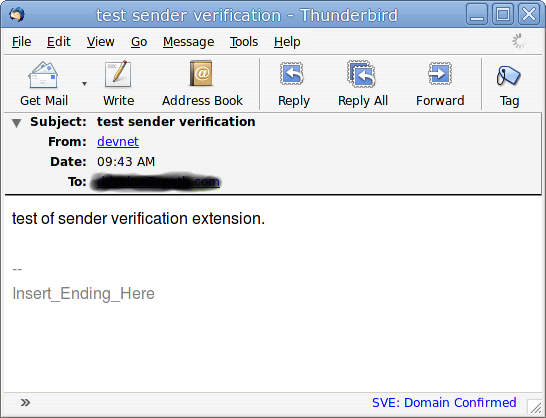
Sender Verification - With the sender verification extension...you can verify that the email that has been sent actually came from the sender. This extension goes out and checks the domain in the FROM field and makes sure that the email originated from this address.

Does it work 100% of the time? No. But for a majority of emails, this extension will make sure that someone hasn't spoofed an email address in your addressbook to bypass your spam filters. The extension uses Sender Policy Framework (SPF) and DNS-based reputation lists to make it's decision and report back to you.

I opened up the preferences for this extension and made sure to toggle "Show verification results in statusbar" so that on the bottom of every email, SVE results display. This even works for previewing mail messages in the preview pane. You can also set individual white lists of domains not to check.

In all, quite a handy anti-phishing extension to make Thunderbird just a bit more secure.

What Obscure Extensions Do You Use?

What obscure extensions do you use to customize your inbox? How do youe extend thunderbird to do your bidding? How does it help you take charge of an unruly inbox? Please share your comments with us here and let us know the steps you've taken to rule over your emails.


24 Ways to Get a customer and Keep a customer

Let's start with the bad news, and there's kind of a lot of it, before we move on the good news of how to fix it. About three-quarters of online shoppers are unsatisfied with their online shopping experience. The other quarter are, flatly, satisfied, in that even bad pizza is good pizza kind of way.


Editor's Note: It's interesting how many ways etailers drop the ball when it comes to customer service. With so much focus on search traffic (front end), it seems webmasters are ignoring their back end responsibilities. Know some effective techniques for better customer satisfaction? Let us know in the comments section.

Sort of anticlimactic, isn't it? The good news is there's a lot of opportunity satisfying customers, even making them very, very happy.

But first, more bad news. Three-quarters of online shoppers surveyed said website content is insufficient to complete research or purchase a product online always, most, or some of the time. Nearly 80 percent rarely or never purchase a product without complete information, and 72 percent will take off to a competitor that does supply that information.

It seems that consumers really want to buy online, but retailers aren't making it easy for them. Sometimes, it seems like retailers go out of their way to lose customers.

My recent search for information about a Polaroid camera comes to mind. In that experience, Polaroid didn't have top ranking for its own product (not even in the top ten), and didn't have sponsored search ads targeting very product specific keywords. The retailers who seemed to pick up Polaroid's slack in the paid results—big names like Circuit City, Target, and Wal-Mart—failed to offer a relevant landing page. When I did find product reviews or pages, the information I wanted (price and specs, mainly) were either garbled by nonsensical rhetoric or was nonexistent.
If researching for myself and not for an article, I would have long before that said, "Screw it. I'll just go to the store myself." All of them lost a potential online customer.

Problems like these aren't uncommon. In fact, it seems many sites are severely lacking in the customer service department. If customers don't prefer online shopping to brick-and-mortar shopping, it's because retail sites haven't done enough to make the online shopping experience a good one.

Ready for more bad news? Here are ways many sites have failed to serve their customers:
  1. Only 37 percent offer multiple images views of products.
  2. Only 33 percent offer customer reviews.
  3. 62 percent have difficult to read fonts.
  4. Only 14 percent allow customers to change the font.
  5. Only 43 percent offer free shipping.
  6. Almost two-thirds do not offer in-stock information on the product page.
  7. While just over half of online retailers have physical stores, only 10 percent offer in-store pickup.
  8. 58 percent do not offer shipping costs early in the checkout process. One third have checkout processes with more than 4 steps.
  9. Only 58 percent correctly answer an e-mail question within 24 hours.
  10. Around 80 percent don't seem to get that more ways to pay means more ways to buy. 20 percent offer pay-by-check, 10 percent offer Google Checkout, 20 percetn accept PayPal and 18 percent offer Bill Me Later.
That's a lot of ball-dropping. Fortunately, it can all be corrected to give yourself a leg up on the competition. Hint: Just inverse some of those numbers above to understand what you should be doing.


Monday, June 30, 2008

Facebook, MySpace Still Fighting For Ad Markets

Competition apparently far from over
Not too long ago, it was discovered that Facebook had become more popular than MySpace on a global level. Only popularity by itself has little to do with profitability, and stats show Facebook has a ways to go in major ad markets.
Whether success in major ad markets leads to profitability is another issue, of course - News Corp. isn't getting rich off MySpace's performance. Nonetheless, as noted by Andrew Chen, MySpace remains on top in the U.S., where the most money is spent on advertising.

MySpace is also ahead in Japan, Germany, and Brazil (the third, sixth, and ninth biggest ad markets, respectively). Facebook has a hold on the U.K., France, China, Canada, South Korea, and India.
If winner-takes-all rules applied in each country, MySpace would still be looking pretty good. But things aren't so clear-cut in real life (look up the recent American Facebook-Visa announcement), and Justin Smith points out, "Facebook is demonstrating that social networks can gain ground against an incumbent in meaningful markets after all."
Maybe Facebook's impending move is a sign that it's even solving the profitability problem.

Local Search Engine Optimization - Revisited

Roughly a year ago, local search engine optimization was all the rage - the new frontier in search engine marketing. For a while, it seemed that everyone was interested in the local search angle - even multi-national companies. However, for many companies selling products or services to the entire United States, or even globally, it seemed like a non-starter. Companies that counted on people looking for certain products or services that did not require close proximity to the company's location were unaffected. As far as local search engine optimization goes, things have changed a bit since then - at least for some.

Some time ago, Google introduced a "geographic box" at the top of its search results. This is tied in to its mapping feature, and, when it was first introduced, the engine would display three results at the top of its search results whenever somebody entered a geographic modifier into the search box ("Atlanta widgets," for example). The Google algorithm then has the intelligence to determine whether the query calls for results that are primarily local in scope.

Since that initial trial, Google has obviously found that its users appreciate the feature. The engine now displays ten local search results at the top of the listings for certain queries, provided that they have a geographic modifier attached. For example, if you type in "Atlanta gyms" in Google, you will see ten results alongside a map that shows the location of ten gyms in Atlanta.
It should be noted that you will not see local search results for all queries that contain a local modifier. In certain instances, it almost seems as if Google somehow "knows" when a geographic modifier really means that you only offer services in a particular area. Yeah, those guys are pretty good.
There are many resources on the Internet to turn to if you are looking for local search engine optimization for your regional website. However, many companies have client bases that cater primarily to a national or international field. Can they benefit from local search?
Yes, they can - in two ways (with a caveat for the first).
First, many customers prefer to deal with people that are local, even if the business is national, or even global. A businessperson that is looking for, say, marketing consulting, may be inclined to work with someone with an address in close proximity found through local search. It just feels more comfortable - if something goes wrong, he or she can request a meeting, rather than calling an 800 number.
Here's the caveat - you may not want people showing up at your doorstep. Some companies invite people to show up at the headquarters and voice concerns or sing praises, but others would prefer to keep things at a distance. This is not a value judgment by any means. With many companies that deal with thousands, or even millions, of customers, it would be impossible to service every complaint with a human smile.

The second way, which seems more customer friendly (but actually isn't), applies when a large company has many locations. This doesn't mean that your company has "walk-in" locations that are open to the public. If you have locations in many cities, each serving a different function, you can still benefit from local search engine optimization.
Say, for example, you are headquartered in Toledo. You have distribution centers in several cities across the United States. Each of your physical locations is eligible to show up in local search results on Google, provided that you supply the engine with the proper information.
Of course, as mentioned earlier, not all searches with regional modifiers attached will bring up regional results. But based on recent happenings, it's a good idea to make your regional presence known and consider the effects of local search engine optimization. After the years of talk about it, local search might finally turn out to be something that most companies can take advantage of.
About the Author: Scott Buresh is the CEO of Medium Blue, which was named the number one organic search engine optimization company in the world in 2006 and 2007 by PromotionWorld. Scott has contributed content to many publications including "The Complete Guide to Google Advertising (Atlantic, 2008) and Building Your Business with Google For Dummies" (Wiley, 2004).

Using Social Media To Drive Traffic

SMO, or Social Media Optimization, helps build website traffic by using social media based websites. The dawning of web 2.0 has seen many different social media websites crop up in an equally large number of different guises. Content sharing, social bookmarking, and collaborative websites form the basis of this initiative and it is these types of website that you need to use in order to leverage the power of the social web.
SMO As Guerrilla Marketing
The nature of Social Media Optimization is such that it could be considered form of guerrilla marketing. Website owners and blog owners have the choice of either investing money or their own skills and time in order to generate traffic from social sites. As long as your efforts are directed appropriately, the more work you put in the more reward you will reap.
SMO As A Link Building Technique
Social optimization also has a happy side effect - it helps to build your link profile so you will usually gain search engine traffic in the long term. Becoming a part of an online community is essential to your social optimization and this, in turn, will naturally provide links to your website. The links will usually be from relevant pages based on a similar topic to that of your own page. The more popular social sites are also given a lot of weight by certain search engines.

Optimize Your Existing Site
Create genuinely interesting, intriguing, or informative pages. Includes images, links, video, and collaborative tools so that visitors really get involved when they do visit your site. SMO is basically digital word-of-mouth and if your website doesn't offer some kind of appealing experience to your visitors, then it simply won't attract the positive word-of-mouth that you want.
Add new pages, if necessary, so that you can include more information. However, don't just add pages for the sake of it - ensure that each page really does have something unique to offer. A website still needs to be well structured.
Get A Blog
Add a blog. Every website has potential blog posts in it so find yours and start blogging regularly. Blog posts tend to attract links from other blog posts and those in turn will spread the word of your website. The more popular your blog becomes, the more value it is perceived to offer and the more visitors you will continue to get.
Be active in those blogs that are within your industry and use your link where permitted and relevant. Don't spam because that will lose you more friends than it will make but if you offer relevant information and a forum or blog allows you to link to it, then offer an insightful comment and provide a link.
Be Active
Being active is a vital part to your whole SMO campaign. Simply registering with social bookmarking sites and content sharing sites is not enough. You need to be involved, post regularly, and generally become a part of the community. If you don't have the time or the inclination to do this then find somebody else to do it instead.
Some Social Sites To Join
You really do reap what you sow in terms of SMO. Determine the sites that are most suitable to your website, join them, and become an active member. Choose some broad topic sites as well as some that are specific to those interested in the industry in which you operate or topic that you cover. Look at social news submission sites, content sharing sites, bookmarking, and networking sites and try to get a broad coverage of all of them. Here are just a few of the sites you should seriously consider using:
Social News/Media Sharing Websites
* Reddit - Reddit is a very popular social news website that boasts a lot of subscribers and covers a wide range of topics.* Digg - Initially, Digg was reserved to technology and related topics but is now a broad topic news site that again has a lot of subscribers and regular readers.* Newsvine - Not as popular as the two above but offering a slightly more formal tone to its content. Again, a good range of topics are covered.

Social Networking Sites
* MySpace - It may be largely riddled with spam but there are still too many genuine users for you to ignore MySpace. You don't have to be an unsigned band to take advantage either.* Facebook - Has caused quite a stir and offers users the chance to create and distribute their own applications as well as content. Another very popular site. * LinkedIn - LinkedIn is a social networking site dedicated to professionals and businesses. It can really help to build a huge network of partners, customers, and other useful contacts in a business network.
Social Bookmarking Websites
* del.icio.us - Register, store bookmarks that you find useful, and include a bookmark to your own website and use a public profile.* Stumble Upon - Same again. Alternatively you can add a Stumble icon to each of your pages, blog posts, and other media and let your readers do the walking for you.
Buttons For Your Pages
Many social websites offer a button that your readers or visitors can use to automatically add a page. Bookmarking and content sharing sites, in particular, have these buttons and if you've ever read a website or an article site then you will have seen the Digg This and Stumble buttons at the bottom of each entry. Users registered with these sites can click the button and quickly add your page. The most popular websites are usually displayed on the high traffic home pages delivering yet more visitors to your site.
Offering Quality
The Social Internet has opened up a whole new avenue for promoting your business, but it needs to be done properly and carefully. Simply tagging, bookmarking, and sharing every page you have regardless of its quality will not bring you the desired results. You may find that it does you more harm than good in the long run.
About the Author: WebWiseWords is a web content writer offering appealing and professional web content. Whether you are looking to implement an SEO or SMO campaign, or you want to improve your visitor's experience while on your website WebWiseWords can create the content you need.

Determining How Long Your Traffic Stays

How long your traffic stays on your website is an indication of how interesting you have made your website.
It is always good to check the number of visitors coming to your site and how long they have stayed. How do you check this? You will check this by your log files. This is done by your c-panel or a similar place depending on what your host has set up for you. Here you can view the different stats about your website.
They will show you:
* Monthly stats-how many visitors came to your site during one month. These will be divided into unique and general (repeat visitors).
* Weekly stats- how many visitors came in 1 week, again they will be divided into unique and general
* Daily stats
* Hourly stats

Most visited pages: These let you know how many visitors have come to certain pages during 1 month. This is where it gets interesting, as you will be able to tell which pages are attracting the most visitors.
The amount of time visitors have spent on your website: This is a good estimate of the quality of your site. Obviously the longer your visitors stay the more chances there are of them buying.
Once you know which pages are attracting visitors you can then work on getting all your pages sticky and compel surfers to visit them.
Google also tracks how long visitors are spending at your site. Again it is a quality check as far as they are concerned. When Googlebots bring information back to the Database about a website being visited and people are staying longer, they can naturally assume the standard of that website is high.
High standard and quality means Google customers (your visitors) are being serviced well and that makes Google happy. This will earn you a higher Page Rank.
Encourage a longer stay:
So we can naturally assume that the longer your visitors stay the better it is. Now how to encourage them to stay? Have you ever read a book that you just could not put down? Well you website must have that same effect on your visitors. They will not want to leave until they have devoured every word of your pre selling content. They should be in the mood to either sign up for your free newsletter and become your leads or go on to your sales page and buy your products or services.

Making them stay: Make your site an irresistible, sticky website that draws your visitor in and compels them to stay. Here are some ways:
* Interesting informative content* Stories, anecdotes, and news about your industry
* Quizzes relating to your industry-the answers will be found on one of your important pages
* Good user friendly navigation
* Humorous jokes, quotes and stories related to your industry-these are often shared among friends and associates (viral marketing).
So try some of these ways to make your visitor want to stay at your site. Use all the resources you have and write that good informative content to pre sell your visitors. Provide them good products and services and see your visitors convert to your loyal customers because you have made your website irresistible to them.
About the Author: Frank Herald. A webmaster and internet marketing specialist Search Engine Optimization Australia.

Video Marketing for Small Businesses

Technology has created video marketing opportunities - cable TV, email marketing, websites and video - for small businesses to be on an even playing field with large companies. From extremely inexpensive video streaming in an email to the full-production TV ad with hired actors, even small companies and home-based businesses can include video advertising in their budget.
You might be asking why you should consider it at all when your current advertising is working just fine. Aside from the fact that adding another strategy to your marketing plan is a good idea, videos are very personal. Who better to discuss your service or product than you? It brings a familiarity to you and your company, which allows the prospect to feel like they already know you. If the message is directed to your current customer base, seeing and hearing you gives the feeling that you are presenting your message directly to them.

There are professional videos and way too often, not so professional videos. Most of us cringe when we hear a car salesman screaming about a wonderful deal waiting for you if you'll come down RIGHT NOW! Or the windows and siding guy who squawks about the fantastic savings if you call within the next 30 minutes (but the ad runs all day long). These are stereotypes of TV advertising available for the small business owner. But it doesn't have to be that way!
Cable TV ads can be very cost effective because you can be specific where your ad dollars will be spent. The cable company has demographic statistics so you can learn what programs are viewed most frequently by your target market then select where (as specific as the zip codes) and when you want your ads to run. The variety of shows cable companies have in their lineup provides a fantastic choice for the advertiser. In addition, they can also slot your ad in during the Big 3 networks' shows as well.
Videos aren't only just for cable TV. There are many companies that create videos which can be linked to websites, newsletters, social networking sites and email signature lines. They serve many purposes from advertising to introducing a new product or service to just send a keeping-in-touch message to current clients. These videos are also used for on-line training and even instructions to learn how to use a new networking website (http://www.OneDegreeConnected.com). Some are scripted, while others are produced to simulate a talk show format. Compare cost as well as professionalism. This form of advertising can be extremely high-quality or can be an embarrassment to your company's image. Get referrals! View some of the finished productions of each company you are considering before signing any contract.
You can even create your own video while sitting in your office. Do you have a video camera or a video cam connected to your computer? You're all set to create your own video stream to be placed in emails or on your website. A word of caution is to make sure it's not too long. Keep it less than 90 seconds and you'll usually keep the viewer's interest.

Video has created the opportunity for business owners to star in their own commercials. Consider the scenarios mentioned earlier of what video advertising could - but shouldn't - be. Luckily, these are the exception and not the rule; most ads are professional from writing the ad copy to the production. Of course, it's important to remember that the familiar saying "junk in, junk out" holds true for video more than any other media. You're dealing with three methods of presenting the message: content, visual and audio.
Therefore, if you choose to take part in your videos, it's best to receive some coaching prior to production. Accent On Business (http://www.accentonbusiness.net), known throughout the United States, will help you with voice and presentation skills. Public speakers, politicians, sports figures, CEOs and others consult with a professional voice and speech coach; so should you. You will have total control over what needs to be said, but they will help you say it with the professionalism that will provide the image you want to present.
New technology has made video marketing very affordable even for the smallest budget. There are a variety of opportunities and one will certainly fit your budget. Consider video in your next marketing plan. You'll find a new media that will present your company with a fresh message and make it personal.
About the Author: Cindy Hartman invites you to view her marketing video at http://www.HartmanInventory.com to discover why you need a personal property inventory. Also learn about a complete business startup package for a business or home inventory service. Let the Hartman's help you start and grow your own personal property inventory service.

Become an SEO Pro

Google is all about linking. And if you want to snatch a top spot in Google's search results you need to link like a pro.
But don't worry. Linking is a whole lot easier today than it was a few years ago. Experience has taught us a lot and with the information in this article you won't need to worry about endless trial and error. We have a repeatable process that anyone can do, as easy as 1, 2, 3.
That said; let's take a look at the linking strategies that Google will give you the most credít for...
Link Strategy 1: Reap the Most Benefit from Anchor TextYou probably already know that anchor text is the clickable word or words that make up a hyperlink. But what you may not yet fully realize is just how powerful anchor text is. Want to test it yourself? Try a simple experiment...
Go to Google.com and search for "clíck here" (without quotes.) Did you get a link for Adobe Acrobat Reader at number 1? Why is that? Check out the page. They have no mention of "clíck here" anywhere on the page or in the META tags.
So why does it rank number 1 on Google for "clíck here"? It's all thanks to anchor text. More specifically, it's because of the countless pages that have "clíck here" as anchor text that links to Adobe's Acrobat Reader download page.
Did you notice how many competing pages there are for "clíck here" on Google? Almost Two Billion! Anchor text is extremely important. Here are a few rules of thumb to get the most from yours...
A.) Use your three most important keywords for your anchor text. Specifically, your most important word 60% of the time; your second most important keyword 25% and your third keyword 15%. And that is for every page you link to (each page should focus on two to three keywords.)
B.) Use "long tail" keywords when appropriate (3 or more words in the keyword phrase.)
C.) If your anchor text is part of a paragraph, like a signature block, make certain the surrounding text is optimized for the keyword you want or close variations. And make sure that text is varied. You want to have plenty of versions of the surrounding text block so Google doesn't ding it as duplicate content.
Link Strategy 2: Make Your Target URLs Laser AccurateURL accuracy, or format consistency, is extremely important. Be sure to use the exact same URL whenever you request a link. Even though a URL link beginning with "http" or "www" (or both) might resolve to the same webpage, Google sees them as different destinations.
Want to find out for yourself? Go back to Google.com and enter "Links: http:// " (without quotes) followed by www... any domain name you want. This will give you the inbound links for that specific domain.
OK, easy enough. Jot down the number of links. Now try it again WITHOUT the "www." And record the number of links. Now try it a third time with the "www" but NOT the http://". Are you getting different numbers? This is because Google sees them as different link destinations.
Link Strategy 3: Go Beyond Reciprocal LinkingReciprocal links just aren't enough any more. Google now discounts the importance of simple link swaps so reciprocal links alone will not do the trick like they used to. But don't worry, with a little time or money or both, you can have the best links imaginable.
The two fastest and least expensive ways are by submittíng your site to directories or paying a link service, but NOT a reciprocal linking service. Let's start with directories...
But before we do, there are two downsides to links from directories that I need to mention. First, Google has been discounting directory links over the past few months. Second, some directories charge a fee to get listed (for example Yahoo charges $299 per year!)
But don't despair. Links from directories may not be all they used to, but they still help your SEO efforts. There's a page I like to check out that has the top directories listed as well as links to the site, their GRP (Google PageRank rating), cost (if any) and more; StrongestLinks.com
You can click on the column headings to sort by any category you want. This makes finding the freebies, or top GPR sites quick and easy. This site also appears to have some sort of paid membership available, but I just use the free link above and it does all I need and more.
Important Note: There is a third possible risk that comes from link farms, which are sometimes very similar to certain link services. That risk is having too many inbound links coming from a single IP range (Internet Protocol address.) Google HATES this and will discount all these links, or worse.
As for reciprocal linking services, I recommend you avoid them like the plague. However there is a nice solution called "3 way linking" that still allows you the set it and forget it option. Here's one service I've had great results with...
3WayLinker.com does not link sites back to each other reciprocally. Instead it creates a series of one way links that are counted purely as inbound links by Google. Even more it helps eliminate duplicate content in your link text and makes sure all inbound links are from a wide range of IP addresses.
Here's how it works... Site "A" links to site "B". Site "B" links to site "C". And then site "C" links to site "A". So each is a true one way link. This also gives the system more options regarding which sites form a team. With reciprocal links, if both sites use the same hosting provider, there is a very high chance you will be linked within the same IP range. With three way linking this problem is eliminated.
So to recap, 1.) Get the most out of your anchor text; 2.) Be very consistent with your link URL, and 3.) Do more than just reciprocal linking.
Now go get that top spot you've been after!
About The AuthorMike Small is a 10 year veteran SEO professional and founder of SEOpartner.com, a free blog dedicated to helping website owners grab the top spots on the best search engines.

7 Ways to Improve the Stickiness of Your Website

Today more than ever, consumers are overwhelmed with choices, and distractions. The cost of attracting users to your website continues to increase and keeping them engaged is more important than ever.Engagement doesn’t end with an individual browser reading content or clicking on an ad. Rather, engagement is an ongoing process that results in loyal customers who come back again and again, becoming more vested in your web site.How can you make sure you’re engaging and keeping customers?In order to create a loyal following, there are some basic principles you need to consider. From first impressions to life-long membership, put yourself in the shoes of your browsers and make their experience a valuable one.1. Reduce Clutter. How many times have you visited a website only to be overwhelmed and confused? What is this site about you may have asked yourself. Or perhaps you found yourself asking, "Where is the information I’m looking for?" Don’t ask your browsers or potential customers to figure this out. Make your site clutter free and create a visual priority that emphasizes the information, resources, or actions your browsers want. By reducing obstacles you build trust among new web site visitors and allow for simple decision making – which benefits everyone.2. Make Navigation Intuitive. There are many ways to navigate a web page but intuition rules the day. Don’t try to get fancy with your navigation or overuse java script. Basic navigation that follows current convention is the best way to lead individuals through your web site to the information they’re looking for.3. Make The Initial Site Interaction Relevant. When a browser reaches your web site, you have less than seven seconds to get them engaged. Making your initial site interaction relevant to what individuals are looking for is essential for keeping them interacting long term. If you are promoting your web site with Google Adwords, or any pay per click advertising for that matter, be sure to create customer landing pages that are truly relevant to the individual who clicks-through your ad. Once you’ve established relevancy, you can move them deeper into your content, tools, and resources.4. Ensure That Your Content Is Up-to-date. Web site content that isn’t up to date does not serve your audience and browsers are likely to move on. One way to ensure that information is timely is by providing a feed of relevant news or information. If including static text on your web pages, try not to include specific dates. However, if you must publish dates, be sure to update this information on a regular basis. 5. Start an Interaction With Your Users. Each time a browser views your web page, you have an opportunity to interact with them. Don’t let this opportunity pass you by. One great way to interact is to offer something of value at no cost. This can be a white paper, access to an exclusive list, or simply a 30 day free trial. Be sure to capture an individual’s valid email address and include them on your mailing list. An auto-responder is best if you wish to engage these individuals on an ongoing basis.6. Provide Plenty Of Support. Don’t hesitate to offer support right from your home page. Prominently display your 800 number, support email address, and additional information for your prospects and customers such as mailing address. This information is viewed favorably by search engines and also creates a sense of legitimacy. Contact information builds trust among prospects and elicits interest in your company.7. Make Sharing Easy. Once you’ve made your web site easy to use, don’t hesitate to offer browsers the ability to share your web site with others. This can be in the form of a simple widget that allows users to bookmark your page, subscribe to an Rss feed, or submit your content to popular news sites like Digg.com. Individuals are much more likely to visit a web site based on a friend’s recommendation versus some other type of marketing initiative. Leverage the power of viral marketing with easy sharing tools.Your web site can be your greatest asset. Unfortunately, many marketers and website owners are so focused on increasing traffic that they lose site of the audience that’s already visiting their web pages but are simply not converting.Don’t make the same mistake. Improve the quality of you site through relevant content that is up-to-date and easy to find. Once you’ve engaged users, encourage them to share. Doing so will make your site perform better, increase conversions, and deliver value for all involved.

Top 20 Contributing Factors For Google SEO

Websites are quickly becoming one of the most popular ways of advertising. Whether it be a business, its product or service or something completely different, everyone of all ages are turning to the web as a method of getting their message out there. With the popularity of this marketing medium increasing and the number of websites always growing, it is obvious that everyone wants to appear at the top of Google's search engine rankings. Achieving such a task is never an easy feat, however with a bit of perseverance, one can definitely increase their chances of reaching that glorious first page result.
Given that there is a heap of websites out there who are on the first page, what is their secret? It is a little industry term called "SEO" and it stands for Search Engine Optimisation. SEO basically consists of the customisation of your website, its content and its internal and external links to assist in the overall indexing and ranking of your website in popular search engines. There are many contributing factors that are used in determining a website's ranking and every search engine is different. This makes trying to optimise your site for Google, Yahoo, Live and the many others quite a pain staking task.
As most of us are aware, Google is currently the most popular search engine for the majority of Internet users. As such, it is only normal that we'd want to focus our sights on achieving a higher ranking within Google first with a hope that the rest will follow. To do this, we must start a journey that could potentially take months before we start seeing any real change, however we have to start somewhere.

Our journey begins by defining some of the key contributing factors that Google uses to determine a website and webpage's ranking within its results. These factors range from keyword use to manipulating internal and external links and the list goes on. To get you started, we have listed the top twenty factors that you should focus on in order to help get your website that little bit closer to the top of the search engine results listing.
Keyword Use Factors
The following components relate to the use of the user's search query terms in determining the rank of a particular page.
1. Keyword Use in Title Tag - Placing the targeted search term or phrase in the title tag of the web page's HTML header.
2. Keyword Use in Body Text - Using the targeted search term in the visible, HTML text of the page.
3. Relationship of Body Text Content to Keywords - Topical relevance of text on the page compared to targeted keywords.
4. Keyword Use in H1 Tag - Creating an H1 tag with the targeted search term/phrase.
5. Keyword Use in Domain Name & Page URL - Including the targeted term/phrase in the registered domain name, i.e. keyword.com plus target terms in the webpage URL, i.e. seomoz.org/keyword-phrase.
Page Attributes
The following elements comprise how the Google interprets specific data about a webpage independent of keywords.
6. Link Popularity within the Site's Internal Link Structure - Refers to the number and importance of internal links pointing to the target page 7. Quality/Relevance of Links to External Sites/Pages - Do links on the page point to high quality, topically-related pages? 8. Age of Document - Older pages may be perceived as more authoritative while newer pages may be more temporally relevant 9. Amount of Indexable Text Content - Refers to the literal quantity of visible HTML text on a page 10. Quality of the Document Content (as measured algorithmically) - Assuming search engines can use text, visual or other analysis methods to determine the validity and value of content, this metric would provide some level of rating.
Site/Domain Attributes
The factors below contribute to Google's rankings based on the site/domain on which a page resides.
11. Global Link Popularity of Site - The overall link weight/authority as measured by links from any and all sites across the web (both link quality and quantity) 12. Age of Site - Not the date of original registration of the domain, but rather the launch of indexable content seen by the search engines (note that this can change if a domain switches ownership) 13. Topical Relevance of Inbound Links to Site - The subject-specific relationship between the sites/pages linking to the target page and the target keyword 14. Link Popularity of Site in Topical Community - The link weight/authority of the target website amongst its topical peers in the online world 15. Rate of New Inbound Links to Site - The frequency and timing of external sites linking in to the given domain.

Inbound Link Attribute
These pieces affect Google's weighting of links from external websites pointing to a page and ultimately will assist in the ranking of that page.
16. Anchor Text of Inbound Link.
17. Global Link Popularity of Linking Site.
18. Topical Relationship of Linking Page.
19. Link Popularity of Site in Topical Community - The link weight/authority of the target website amongst its topical peers in the online world.
20. Age of Link.
Negative Crawling/Ranking Attributes
There are also some points we should make before you start getting your hands dirty. With any type of SEO marketing, there are some things that can actually have a negative impact on your ranking. These following components may negatively affect a spider's ability to crawl a page or its rankings at Google.
* Server is Often Inaccessible to Bots.
* Content Very Similar or Duplicate of Existing Content in the Index.
* External Links to Low Quality/Spam Sites.
* Duplicate Title/Meta Tags on Many Pages.
* Overuse of Targeted Keywords (Stuffing/Spamming).
It's now time to get busy! Start prioritising your tasks, modifying your content and building your internal and external links to meet some of the above guidelines. Keep in mind that improving indexing is mostly a technical task, improving ranking is mostly a business/marketing strategy, what might work now may not work in the future and finally, it takes time. Loads of time. Still, with a bit of trial and error and a good dose of persistence, you can achieve the search engine ranking you're after.
About the Author: Jon Bergan is the owner of Bergan Blue, an Australian based creative design firm focused on bridging the gap between the online world of the Internet with the offline world of Marketing. Please visit http://www.berganblue.com.au/ for more information.

Test Your Way To Greater Conversions and Internet Success!

Testing your website pages, especially landing pages, squeeze pages and sales pages is one of the most profitable things you can do to tweak your pages and gain higher conversions. On top of that, you can learn more about copywriting though split tests and other means of testing your web pages than any other way.
Back in the days of mail order marketing, testing sales letters and catalogs gathered more real information about new concepts and ideas than through most other methods of research at that time. In these days of the internet, the bell even rings louder.
You can test whole concepts of your pages to find out what emotional triggers and core desires your market truly respond to. Simply test two or three versions of your sales page that each focus on a separate theme or slant on the product or service. The page that pulls the most conversions will give you the answers you are looking for.

In this day of fierce online competition, testing is something you should, no MUST do to gain the highest conversions from your website and pages. If you're not actively testing your pages, your competition will soon pass you by.
What Exactly Should You Be Testing?
The simple answer is: Everything! Everything on your pages and in your sales message is a contributing factor to your conversion rate. This includes your headline, opening paragraphs, body copy, your offer, post scripts, background color, font, font colors, images and every imaginable component of your page in between.
Volumes of information have been written about what to test and how to test your web pages. This work is extensive, so when you begin to test, I suggest you concentrate your first efforts on the three areas that have been shown to have the most impact on your sales page, the headline, the first three (or four) opening paragraphs, and your offer.
In this article, I will focus on Headlines as they are the critical element of your page.
Testing Headlines
Headline changes can have the most impact on your conversion rate and response of these three components. 75 - 80% of your visitors will never read past the headline. It doesn't matter how wonderful you have written your sales page, if the headline doesn't work correctly and do its job of getting people to read on, your page will be a failure.
In order for your headline to be effective, you have to discover the biggest core desires within your market to feed. The best headline test are based around the different core desires and motivating reasons why people would be interested in your product or service.
Testing different headlines around different concepts will tell you which one is more appealing to your market audience. Once you have the key concepts and desires tested and you have discovered which one works best, you then go to work tweaking your headline in more alluring and persuasive ways.
Split testing is generally used to test headlines. In the beginning, you will probably want to use simple A/B split testing but if you are dealing with high volume traffic and high price sales, you may want to consider speeding up the process with multi-variate testing. You can find out more about these tests by going to: What Is Split Testing?.

What Type of Headline Format Do You Test?
There are some classic headline formats that have been shown to be effective over time that you can begin with. There's the "If/Then" headline, "Amazing Secrets of ..." headline, the "Who Else Wants to ..." headline, and of course the classic "How to ..." headline.
Test as many headlines as you can think up for your web page. In fact, you should never stop testing different headlines on your page. A simple 10% increase in your conversions could result in hundreds to tens of thousands of dollar or more. Testing your headlines could bring an increase of 50%, 100%, or even 200% or more in the response your web page brings.
The next time that you feel that your landing page, sales page or squeeze page should be converting better, think about testing the component of your page to increase the effectiveness and response that it should be eliciting.
Continue reading more about this fascinating arena of online marketing by going to: Testing Your Web Pages.
About the Author: Jim Bruce is a SEO Web Consultant and writes frequently about search engine optimization techniques and search marketing. You can find out more about these topics by going to Ristvin Marketing.

Website Optimisation Techniques

As well as link building and on-page optimisation, there are some other very important SEO factors which can help your website index and rank in search engine listings. The following techniques are grouped into the category named 'website optimisation' and should not be overlooked when preparing an SEO campaign.
Domain Age and Expiration Date
Google and other search engines include many factors within their ranking system. One of these factors is trust rank. Owning a domain that has history improves the trust rank as does registering the domain for a long period of time.
Website History
Again trust rank comes into play here. If your website has been archived in the search engine results for a long period then it will help improve rankings and indexing of webpages created in comparison with a fairly new website with no history.
As well as link building and on-page optimisation, there are some other very important SEO factors which can help your website index and rank in search engine listings. The following techniques are grouped into the category named 'website optimisation' and should not be overlooked when preparing an SEO campaign.
Domain Age and Expiration Date
Google and other search engines include many factors within their ranking system. One of these factors is trust rank. Owning a domain that has history improves the trust rank as does registering the domain for a long period of time.
Website History
Again trust rank comes into play here. If your website has been archived in the search engine results for a long period then it will help improve rankings and indexing of webpages created in comparison with a fairly new website with no history.As well as link building and on-page optimisation, there are some other very important SEO factors which can help your website index and rank in search engine listings. The following techniques are grouped into the category named 'website optimisation' and should not be overlooked when preparing an SEO campaign.
Domain Age and Expiration Date
Google and other search engines include many factors within their ranking system. One of these factors is trust rank. Owning a domain that has history improves the trust rank as does registering the domain for a long period of time.
Website History
Again trust rank comes into play here. If your website has been archived in the search engine results for a long period then it will help improve rankings and indexing of webpages created in comparison with a fairly new website with no history.
As well as link building and on-page optimisation, there are some other very important SEO factors which can help your website index and rank in search engine listings. The following techniques are grouped into the category named 'website optimisation' and should not be overlooked when preparing an SEO campaign.
Domain Age and Expiration Date
Google and other search engines include many factors within their ranking system. One of these factors is trust rank. Owning a domain that has history improves the trust rank as does registering the domain for a long period of time.
Website History
Again trust rank comes into play here. If your website has been archived in the search engine results for a long period then it will help improve rankings and indexing of webpages created in comparison with a fairly new website with no history.

Structured Navigation
When creating a website, it is important to provide a well structured navigation, not just for users but also to allow search engine bots to follow links and index webpages within your website. Structuring your navigation correctly can help all you webpages be indexed and should help the flow of Google's PageRank spread through out the website.
Valid HTML
As with structured navigation, the importance of valid HTML to search engine bots is to allow all webpages within your website to be indexed within the search engine listings. Validating your HTML will ensure that the bots do not hit any 'brick walls' within the code that prevent them from reading the rest of the webpage.
Contextual Linking
To further help the indexing of your webpages and to even out the flow of Google's PageRank, it is useful to include links within the content text of your webpages. Wikipedia is a perfect example of how this should be done.
URL Structure Including keywords in your website's URLs will help you rank for those terms. If your website uses dynamic URLs created through variables then think about rewriting them. Separate keywords using a minus character (eg. search-phrase.html) and try and keep the important keywords as close to the beginning of the URL as possible.

Regional Targeting
If you wish to target a certain region then there are a few steps you can take to help this process. Firstly you can choose a relevant domain such as a .co.uk (UK) or .de (Germany) rather than a generic .com domain. Then look at your hosting IP location, search engines can access this information and will use it to decide your target audience. Finally, Google Webmaster Tools allows you to set a geographic target which is useful if you have a .com domain.
Site Maps
Search engine bots look for site maps when they visit your website. Providing a standard HTML site map will help improve the indexing of your webpages and allow bots to find webpages that they might otherwise have missed. You can now also provide and submit an XML site map which all the major search engines have took on as a standard. Use your robots.txt to tell bots where to find your XML site map and also submit it to Google Webmaster Tools and Yahoo Site Explorer.
Domain Name
If you are purchasing a domain name for a new website then think about including your main targeted keywords within that domain name. For example if you are building an online store that sells low price golf clubs in the UK and you buy the domain cheapgolfclubs.co.uk then you are definitely going to have a lot more of a chance for quickly ranking well for the search term 'cheap golf clubs' in UK search engines than you would with a more generic domain name. You would also do well for long tail search terms such as 'cheap golf clubs in the UK' and have more chance of ranking for 'golf clubs' in the long term.
About the Author: Steven Balfour wrote this article for search engine optimisation company Position Gold Ltd.

6 Qualities of a Good Domain Name

Choosing a good domain name is crucial to the success or failure of your business. You may wonder how something so small and slight could have an impact on your business, but the best way to compare this is to think about how important location is to an offline business? If you do not have a good location, you are likely not going to get many visitors. The same holds true for a good domain name as well.
Here, you will discover the six qualities that a good domain name must have to ensure maximum success.
1.) Memorable
A good domain name must be memorable. Yes, we have the option of bookmarking a site that we enjoy; however, the hard truth is that many people do not take advantage of bookmarking. Therefore, it is necessary to ensure that your domain name is one that is easy to remember and makes an impact. It should be easy, memorable, and straight forward.


Avoid complexity and it is usually a good idea to avoid initials in most cases. The only exception to this rule would be if the letters represented the website name or business and was still easy to remember.
2.) Short and Sweet
Twenty characters is the maximum that you should use for a good domain name, ten is even better. A long and complicated domain name is not going to help you. Your best bet is to keep it short and sweet. A great domain name is less than ten characters; a good domain name is less than twenty characters. A bad domain name goes over twenty characters.
3.) Be Choosy On Your Extension
There are several domain extensions available to you such as .com, .net, .org, .tv, .info, .gov and so on. However, some of these work better than others and are more memorable at the same time. It is important to understand that some extensions also have restrictions such as .gov is reserved specifically for government websites. The .com domain name extension is the best by far, because it is the most widely used.
The .net extension is the second best, but be prepared most people will type .com before they will .net if they cannot remember which extension you use. The type of extension you use might also have a bearing on the type of website. Some people have come to expect certain things when a particular extension. For example, .org is typically used by not-for-profit organization and educational websites. The .info extensions are generally used for informational websites.
4.) Spelling Means Everything
Having a difficult to spell domain name could cause you some trouble. Again, many do not even make use of bookmarks; therefore, if your domain name is hard to spell, they may end up at a competitor's website.

A good domain name contains only words that are easy to pronounce, have a good combination of words or letters that are used in every day language, and does not contain foreign words that may be difficult to non-native speakers.
5.) Tells a Story
A good domain name should be descriptive and tell a story. In other words, when your visitors, customers, or potential customers see your domain name they should instantly be able to tell what they are going to find. For instance, if it is your business, a business name is good.
6.) Avoid Fancy Symbols
It is never a good idea to use numbers or hyphens within your domain name. Even if your domain name is memorable, many people will not pay attention to the symbols, which could lead them to someone else's website.
About the Author: Joseph Nyamache has the worst domain name. Learn not to make the same mistakes at expired domain names blog.

Creating a Corporate Writing Style

Developing a corporate writing style will unify your company's communications and create a unique 'voice' that enhances corporate recognition and brand awareness. To ensure that your corporate writing style is applied consistently, you need a style-guide.
Writing style refers to the words and expressions - as well as to the spelling, grammar and punctuation - a person uses when writing letters and memos. Each of us has a personal style of writing which, like our speaking voice, is usually recognizable.
To distinguish itself from its competitors your company also needs its own writing style, one that will make it recognizable and enhance brand awareness.
The problem is that corporate communications are written by many people, each with their own personal style. This is especially true where particular documents, such as newsletters, technical manuals and corporate brochures, websites and ezines, contain contributions from several people.

Thus there is a need to create a company writing style that unifies written communications and reflects corporate identity and image.
If you examine the brochures and websites of major corporations you'll see that the style of writing varies - sometimes subtly but always distinctively - from one company to the next. You will also notice that the corporate literature of each particular company reflects a unified style, as if it had all been written by the same person, ie the same corporate personality.
The best way to achieve a unified writing style that is stamped with your corporate personality is to create a document called a style-guide.
A style-guide is a booklet that covers word, phrase and sentence usage, and approaches to be taken in structuring particular types of communications, such as brochures, technical manuals or ezines, as well as common errors in grammar and syntax. It lays down the 'rules' to be followed when writing corporate literature.
A style-guide should provide your corporate communications with a distinct vocabulary and cadence that is appropriate to your business. Obviously a writing style that is suitable for a financial services company or bank must differ greatly from the style of a fashion house. An appropriate style-guide will provide your company with the overall tone and word-quality you need to communicate successfully with your target audiences.
When devising a style-guide, an independent consultant is essential to preserve objectivity. Giving the job to an in-house executive may result in writing style that is contentious because everyone within your company is likely to have views on what is an appropriate and 'correct' style. An external writing consultant will have the experience needed to devise an appropriate style - it's his main job after all.

The consultant will begin with an examination of your company, its marketing efforts, communication channels and target audiences. He or she will also peruse the company's marketing communications and other corporate literature. This getting-to-know-you phase must be done thoroughly which can take time.
Once he understands your company, its communication objectives and typical audiences, the consultant will be in a position to draft a corporate style manual and agree its content with senior management. To illustrate the value of the proposed writing style, he or she should rewrite some of your recent corporate literature and show how the proposed style will enhance corporate recognition and branding.
You should always ensure that the final guide is delivered in electronic format so that it may be printed and distributed among your staff without restriction. Once it has been issued, you will also need to take steps to ensure that the writing 'rules' are followed in all communications with markets and stakeholders.
A well-thought out writing style-guide with clear understandable rules, which are applied consistently to all corporate literature - print and electronic - will ensure clarity and harmony in your corporate communications and reinforce corporate personality. It's just as important as your logo and visual imagery.
About the Author: Paul D Kennedy is a business consultant and writer. His writing services solve corporate writing challenges and imbue business communications with clarity, impact and persuasiveness.

Monday, April 21, 2008

3 Steps to Driving the Right Traffic to Your Website

One of the biggest challenges many of my clients face is getting enough visitors to their websites. And not just any visitors, but the right kind of visitors - the ones who are high quality prospects for you.There are literally hundreds of ways you can drive the right kind of traffic to your website, and usually a combination of several brings the best kind of visitor to your site - the ones who are most likely to take action with you - whether that's to sign up for your teleseminar, join your bootcamp, buy your info-product or simply sign up for your ezine list.But once we get into looking at a client's site, the piece we often find missing is a clearly defined niche. If you don't know who your target clients and customers are, it makes it really difficult to find them and to let them find you.
Step #1. Who is your target market?Once you define who it is that you're most meant to serve, the easier it will be to know where and how to find them.Once you have a clearly defined niche, you want to be sure that your website is optimized in the sense that it's ready for the traffic that you're going to be sending to it. There are two essential pieces that you need to have in place before you start driving that traffic to your site:~ An Invite Site:This is a simple one-page website where you direct your target market to sign up for your list.~ A Free Taste:This is your free offering to entice people to join your list once they arrive at your Invite Site.I'd like to invite you to take a look at your website and make sure that it's super-clear what step people should take when they arrive. The first thing that your visitor should see is the sign-up for your Free Taste.If you're going to make the effort to get people to your site, you want to make sure you have a way to capture them once they get there to get them on your list and in your marketing & product funnel. Following this model is a foundational piece to building a successful and sustainable business online.One you have that foundation in place, you need to find ways to access your niche, to get in front of them, so you can drive traffic to your website. There are two key ways to drive traffic to your site:
Step #2. Find ThemThe second key to driving traffic to your website is to find out where your target market is hanging out online. Here are some ways you can do that.> Join Online Networking Groups/Discussion List/Forums/BlogsFind 3 online networking groups and list your profile and website address that points directly to your sign-up page for your Free Taste. Some great groups can be found on Ryze.com and LinkedIn.com. Search Google Groups or Yahoo Groups for other groups that apply directly to your niche.The key to utilizing this tool is to build that relationship with your target market, not to sell anything. Every list has it's own set of rules, but most lists will allow you an email signature where you have your URL listed that points to your Free Taste on your website. Many lists also have Promo days where you can point people to your website as well.> Offer Free TeleseminarsAnother way to get in front of your target market is to offer free teleseminars for groups and associations that are made up of your target market. You invite people to visit your site during the teleseminars, and/or when they register - depending on how the association wants it set up. Associations are always looking for speakers, so put together an offer to speak and send these out.> Do Internet Radio or Podcast InterviewsOffer to be interviewed for a Internet radio or podcast show whose audience is your target market. Make sure you are able to give the URL of where you want people to sign up for your Free Taste. To find an appropriate show, Google "your niche + podcast" or "your niche + radio shows."
Step #3. Let them find youThe third key is to leave clues for people to find you online.If your niche isn't clear in the sense that they're not necessarily hanging out together, this is sort of a sideways way to reach them.> Pay-Per-Click AdvertisingGoogle Adwords or Yahoo Overture are the two biggest players in the pay-per-click arena. You can create a PPC campaign for a very small investment, and because you have complete control over your budget, you can set it for whatever amount you feel comfortable with. It's very difficult to get to the top of the "organic" search results (on the left side of the search results page) but can be very easy to get on the first page of results with a PPC, bringing targeted traffic to you. And, the best part is you only pay when someone clicks your ad that takes them to your website.Use the PPC's research tool to help find the best keywords for your target market (keywords are just search terms that help people find you online), and then use them in your articles to help the search engines drive traffic to your site.> Write & Submit ArticlesThere are several reasons why you want to implement this strategy. One is to educate your target market about you and what you do. Another is that it helps to position you as an expert. And another reason is that your articles give people a taste of your style, what it is that you offer, and it gives them an opportunity to get to know you a bit without risking anything.When someone enters your keywords in the search form, your article will pop up and that will drive traffic to your site.> Optimize Your Website for the Search EnginesYou'd have to be a full-time search engine optimization expert to keep up with all the changes the major search engines make, but there are a few basic things you can do to help your site come up for relevant searches. Here are some to get you started:a. Define your keywords - this is how people will find your business online. The trick is to find keywords that are highly relevant to what you offer and popular enough that they will attract decent traffic to your site, but not so competitive that you can't rank well using them. Use your keywords in your web page copy.b. Create your metatags - this is how the search engines "read" your site. Put your keywords in your metatags on each page of your website.

3 Best SEO Tips of 2008

Every year I dedicate from January to March looking for the absolute best and most original search engine optimization tips of the previous year's end. In 2008 I have rounded up the very best three SEO tips that I've seen in a decade!
SEO Tip #1: Make Google Alerts Your Personal Online SpyGoogle Alerts is a great way to let the world's biggest search engine be your personal online spy. This takes search engine optimization insider info to whole new level. Here's an excerpt straight from Google...."Google Alerts are email updates of the latest relevant Google results (web, news, etc.) based on your choice of query or topic.Some handy uses of Google Alerts include:* monitoring a developing news story* keeping current on a competitor or industry* getting the latest on a celebrity or event* keeping tabs on your favorite sports teams"As you probably guessed, it's the second one we care about most, "keeping current on a competitor or industry."Here's how it works... Each time Google finds a reference to the query or topic you request you will be sent an email with the details. This is like having an online spy to make sure competitors are not using your protected keywords (trademarked names, company names, etc.) It's also an instant identifier to know when your site or product is mentioned in a news story or even when a topic is hot so you can take advantage of the situation. It's the easiest way in the world to stop competitors' dirty tricks and identify trends that you can take instant advantage of.It's fast, free and works every minute of every day. Let Google Alerts (http://www.google.com/alerts) do your most time consuming legwork while you reap the rewards!
SEO Tip #2: Optimize Your 404 Page and Always Be Found"Error 404: Page Not Found" is a blessing that most Webmasters curse. Why? Getting a visitor on any page of your site is fantastic! Don't blow the opportunity. Not only can you make your "404" page a valuable sales tool, you can use the following search engine optimization techniques to attract customers in droves.A.) Use your main keyword in your title, add a "pipe" (usually above the Enter key) and then use your secondary keyword. Here's as example for an SEO site "SEO Search Engine Optimization Tips"B.) Add some keyword rich content using one to two keywords for the page. If you have less than 250 words on the page, just use one keyword and use it no more than three times total. Bold the first use and italicize the second or third use. Keep in mind this is an "inactive" page so simply tell the visitor what your site is about and whet their appetite with a good description. Something like this works well... "Thank you for visiting SEO (bold) Group, Inc. We are sorry you landed on a missing page but don't worry, if you're looking for the very best search engine optimizations tips (bold), you're at the right place..." This will go on for a couple paragraphs or as long as you'd like then end it with something to the effect of "Please Click Here (link) to visit our site map or click any link to the left."C.) Add your site's standard navigation system (bar, column, etc.) as mentioned above.D.) Make the look and feel of the customized 404 page match your main site as closely as possible with a template, matched palette, cascading style sheets, etc.E.) Create a link to the site map page if available, and make the link easy to find. You want your visitor off the 404 page and into your main content as quickly as possible.Setting up a custom 404 page link usually takes less than five minutes on most major Web hosting companies like Godaddy.com. But whatever it takes, it's worth the effort.
SEO Tip #3: Get (Even More) Serious About LinkingI saved the most important for last. If you want to do well on any search engine, especially Google, linking is THE single MOST important thing you can do. It's that simple.Here are the five things you MUST do to make your site #1 on Google:A.) Find the highest page rank sites linking to your site AND your competitors' sites.B.) Run monthly link campaigns and snatch up the best of the above identified Web sites.C.) Run regular checks on what pages are still linking back to your site. Alsomake sure they did not move you from a high page rank page to a lower one (don't get cheated!)D.) Eliminate any penalized sites you link to; ASAP!E.) Check your search engine ranking AND your competitor's for each of your keywords every week. Do this, at the minimum, for Google, Yahoo, MSN and Alta Vista.Inside Tip: Keeping up can be a lot of work so a lot of SEO Consultants (myself included) use SEO Elite (http://www.SEOeliteWeb.com) to do all the most difficult and time consuming work.There's one more very important thing to know; Google was originally a Ph.D. student's project and was created for the sole purpose of defining a Web site's value by the sites that link to it. Twelve years later this is still it's main job. Linking is EVERYTHING to Google.These few SEO tips are the very best of the best so use them wisely. Best of luck!

The ABCs of Domain Names

Everything on the Internet starts with a domain name!
I know that may come off as a bit over reaching - but its true. From email to news, search, video or anything else on the Internet - you have to know where you're going which is only achieved by a domain name.
The ABC's of domain names, which as a title may come off as a little corny to you, is an exercise that makes you think about your industry or business, what you're doing in it, and how you go about doing what you do as it relates to domain names. The use of the ABC's format is to provide a simple, back to basics approach to deliver fundamental concepts that provoke thoughts, ideas and questions on domain names and how they are a part of your world.
So, whatever all of that means - lets dive into the ABC's of domain names and find their relevance in your line or work, personal life, hobbies, educational background, experience or special areas of interest to see what jumps out and comes naturally to you:
A: Advertising - domain names offer the perfect venue to advertise your product or services or to provide potential revenue by domain parking and/or affiliate programs.
B: Branding - the brand is in the name. Having a great targeted domain name can really build a brand, or can actually be the brand (eg: Google.com)
C: Community - the Internet is all about an interconnected community. Through domain names, you create a real destination and an identity for what can become a community.
D: Direct Search - having a generic word based domain name is your best path to direct search traffic. Direct Search is here to stay and will likely take an increasing share of the overall search marketplace. Direct search bypasses the likes of yahoo.com and google.com as the user types in the destination site directly into their browser (ie: www.computers.com).

E: Ecommerce - want to conduct business online - you need to start with one primary thing - a domain name. Ecommerce is one of the leading uses of the Internet.
F: Friends & Family - connect with your friends and family with domain names - either by email, your favorite websites, or photo sharing sites and videos, etc.
G: Global - synonymous with the Internet - domain names (particularly .com) have mass broad appeal on a global basis, with global potential.
H: High Returns - where else can you buy a piece of virtual real-estate for $8.00 and sell it within a matter of weeks or months for over $1000? Fund.com just sold for $9.99 Million in March of 2008.
I: Investment - domain names are appreciating more than any investment for the price. Similar to investing in stocks, bonds, real estate or insurance - domain names offer what I believe to be stable long lasting appreciation with the potential to create astonishing returns. Want to learn more about domain investing - you can always check out www.domainprofitsbook.com.
J: Justify - Justify your web presence and online business with a great domain name that demonstrates who you are and what you do.
K: Keywords - domain names can be based upon major key words for your industry or target market. Just the same, the key words you use in your Internet marketing can be generated from the domain name you choose and how it relates to your target industry/product/service/noun/verb.
L: Localization & Location - targeting niche audiences by location and a specific geography has proved to be a very strong, identifiable marketing opportunity for anybody online. Embracing localization for your domain investment objectives is a great path to consider.
M: Monetization - making money and creating multiple sources and streams of income are the cornerstones to the potential and reason why people buy savvy domain names.
N: New Markets to seize - new products and services are always being launched, just as new companies and markets are being formed. Finding with a good strong domain name to capture the essence of your business or target market for your online presence is always a great starting point.
O: Organization - a domain name is the perfect way to identify with your organization. Whether it's a product, service, or brand - your domain name is your face on the Internet.
P: Profits - Domain are a great way to make money and profits. Invest wisely and you can find yourself with a great windfall.
Q: Quest - Like any business venture, you are on a quest to explore, learn and make money.
R: Revenue - domain names offer a myriad of ways to generate revenues. There are numerous ways and avenues to generate revenues with domain names, however, in some cases are closely held ideas and resources. Becoming educated about domain names and being focused on creating a long lasting business is a great path towards generating revenue.
S: Search Engines - Search engines are the gateway to choices on the Internet and essentially, a directory of domains classified by the type of information, product or service they offer. Search engines are a powerful marketing tool and a source of traffic for the domain name owner.
T: Technology - simply, without technology, there are no domains, websites, search engines, email or the like. The beauty of domain names is that you really don't have to understand or learn too much technology to get started, or to make money.

U: Unique Users - people coming to your website/domains generate traffic. The more unique users that visit your website - the more traffic they create. The more traffic - the greater the value. The best way to create long lasting value with domain names is creating a venue where a consistent and growing base of unique users visit your domain name/website.
V: Virtual - Domain names are virtual real estate. Some represent ocean-front property while others can represent sky scrapers, apartments or vacant land in the middle of a barren desert. Build your portfolio of virtual real estate for the longer term or flip your domain name for a quick sale and profits.
W: World Wide Web - The world wide web and its beginning started with domain names and/or their underlying numerical identities. With the advent of the world wide web, email, search engines and the increasing convergence of communications and media - business and industry has created high demand and appreciating values for good domain names.
X: The X Factor - there is a mystique and certain unknowns regarding the true value of domain names, how to create revenue and profits, and what strategies are best to create traffic to your domain name or website. The more knowledgeable and prepared you are to dive into the domain name world - the better off you are in managing the X Factor when it rears its head.
Y: You - buying, selling, and owning domain names is a reflection upon you, what your goals are, where your interests lie, and how you want to make money with this virtual real estate. You need to decide what your objectives are and how you are most comfortable in approaching your investment and dedication towards making money with domain names.
Z: Zeal - approach your domain activities with passion and enthusiasm. The more positive your thinking and focus is with domain names - the better you will be able to manage it, be prepared, and have an open mind to seize new opportunities and make money with your domains.
We hope you enjoyed this article and find that each time you read it you take away something new and different that can add value to your world of domain names.
About the Author: This article is written by Chris Kern. Chris has been a serial entrepreneur, corporate finance specialist and domainer for the past 13 years and is the author of the authoritative resource book on domain name investing "How To Make Money With Domain Names" which can be found online at: http://www.DomainProfitsBook.com. "Everything On The Internet Starts With A Domain Name" is a Service Mark of Chris Kern.

SEO For Local Markets

Many brick and mortar companies that are catering to their local clientele find it hard to SEO for local markets despite targeting the best keywords. Quite naturally this is not a surprising matter as many of them, although efficient in running their off line businesses, typically stumble over two critical blocks.
Stumbling Blocks and SEO for Local Markets
When local businesses set to do SEO for local markets, many of them invariably ignore the need to think rationally because they are advised by SEO experts to target the big three search engine users and sometimes get confused and tackle this feat on a global level resulting in global traffic. The direct fall out of this step is exposing your business offers, products or services to the world at large only to dilute all other local online SEO efforts. If your product is not global you are in trouble.

So here is the stumbling block number one.
1. Not using localized target keywords, however good they are, will leave your new websites way down the SERP's locally. Actual localized keywords you should be targeting in which will bring you a steady stream of natural traffic.
The second block where you might probably stumble, especially if you are new to web and optimization is wrongfully assuming internet marketing techniques as something radically different and for removed from the earthly- worldly affairs that we all do by trial and errors over and again. The crux of the matter here is SEO for local markets is only a small part of larger marketing exercises, with certain twists, to get exposure with local locations.
Here is the second stumbling point in SEO for local markets.
2. SEO for local markets is not a marketing technique but a sophisticated local technique of optimizing websites on a local basis. Obviously, the one who knows the pulse of the market is not the SEO expert but can contribute his knowledge to SEO expert.
So, What Is Actually SEO For Local Markets?
Let me dash you through steps involved in SEO for local markets in short.
1. Localize your target keywords. This includes prefixing or suffixing local terms, names, and names of areas, cities or zip codes with target keywords. Example: "remodeling contractors Orange County", not "remodeling contractors".
2. Submit to local search engines (find one, if you don't know already), directories and web based yellow pages.
3. Display your mailing address with street address, zip code and complete. Once your site is indexed, these words gain prominence as a part of content.
4. Submit to local listing sections of Yahoo and DMOZ which is in addition to generalized listing.

5. Don't leave out general SEO techniques because you want to SEO for local markets which the power of link building which can be done globally as there might not be enough local sites to beat you competition.
6. Get on the local maps of Google, Yahoo, as this generally puts you on front of the local search engines.
7. Exchange links and banners with local businesses as the local traffic exchange will bring you new business. Avoid changing banners or links with competitors but exchange them with businesses that will complement you. Verify their traffic so it's an almost even exchange.
Dominating local SEO can be done fairly easily, you just have to either hire a professional with a proven track record or take time to learn local SEO. The main concern is to be patient as it takes at least 3 months to start seeing results.
About the Author: Michael S. Francis the author is a seasoned local SEO expert. Michael S. Francis is the owner of www.seovida.com a Local Business SEO company. Click the link below and join the subscriber list on the home page to take a free local SEO class so you can learn the basics of local seo click here Local SEO.