/* */
Showing posts with label Search Engine Market to Consolidate. Show all posts

Wednesday, July 02, 2008

Making Your Email Experience More Enjoyable

I recently searched through the mozilla thunderbird extensions website and found 4 extensions that I didn't know about that actually prove to be quite useful.

I use Thunderbird 2.0.0.12 on Foresight Linux and have tested all of these extensions and verified that they work on that environment. Hopefully, they'll help someone craft a more enjoyable email experience.


Search for Sender - If you're like me, you like to group like items together in your inbox. With this extension, you can group emails from the same sender as quickly as a right click. Really, it's just a shortcut that places the sender email up into the search box and searches for you. The nice part is, with this extension, you don't have to type it. Quick, easy, and simple. This has quickly become an extension that I cannot live without.

SyncMab - SyncMab is an extension similar to foxmarks for Firefox. With foxmarks, you keep all your bookmarks on a central server of your choosing so that your bookmarks are the same across all computers you use that have Firefox installed. This is perfect for me since I have a set of work bookmarks and home bookmarks and like to be able to switch back and forth between them. But what about thunderbird? It doesn't have bookmarks right? Exactly, but it does have contacts in your addressbook! So, you'll be able to save your contacts to a server of your choosing and then on another computer with thunderbird you can synchronize your contacts by downloading that file using SyncMab. It's brilliant and allows you to always have the same contacts across operating systems, across computers, and even to maintain multiple addressbooks.

Display Quota - This extension will display a small graphic in Thunderbird that tells you how much space you have left in your IMAP mail account and can warn you when you get close to filling up. This might not be too useful for those of you that use IMAP with huge quotas (gmail) but for others, it may be. I have heard that some users do not like the popup that displays for warning on this extension. For those users, Thunderbird has a built in function you can enable:

Open your configuration editor in Thunderbird and find the following keys:

1. mail.quota.mainwindow_threshold.show - % when quota should show up

2. mail.quota.mainwindow_threshold.warning - % when quota becomes yellow

3. mail.quota.mainwindow_threshold.critical - % when quota becomes red

Thanks to goddess-gate.com for information on how to do this.
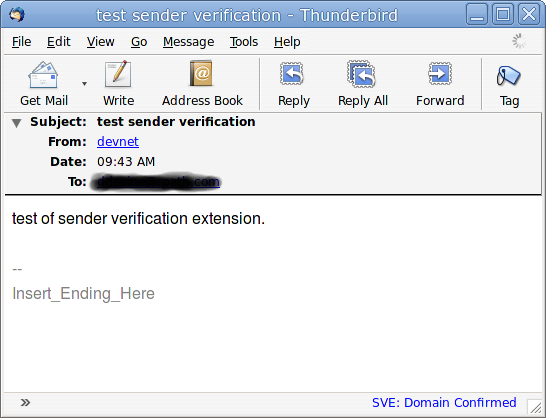
Sender Verification - With the sender verification extension...you can verify that the email that has been sent actually came from the sender. This extension goes out and checks the domain in the FROM field and makes sure that the email originated from this address.

Does it work 100% of the time? No. But for a majority of emails, this extension will make sure that someone hasn't spoofed an email address in your addressbook to bypass your spam filters. The extension uses Sender Policy Framework (SPF) and DNS-based reputation lists to make it's decision and report back to you.

I opened up the preferences for this extension and made sure to toggle "Show verification results in statusbar" so that on the bottom of every email, SVE results display. This even works for previewing mail messages in the preview pane. You can also set individual white lists of domains not to check.

In all, quite a handy anti-phishing extension to make Thunderbird just a bit more secure.

What Obscure Extensions Do You Use?

What obscure extensions do you use to customize your inbox? How do youe extend thunderbird to do your bidding? How does it help you take charge of an unruly inbox? Please share your comments with us here and let us know the steps you've taken to rule over your emails.


Monday, March 24, 2008

Google Sacrifices Clicks To Increase Advertiser ROI

Google investors are still at the table eating their losses after comScore's report that paid click revenues were flat in the month of January. Impending recession was the chief suspect among speculators, but nobody finds any real support for that. More astute observers noticed that revenue flattened very soon after webmasters began reporting on decreases in AdSense earnings.
Editor's Note: It's hard to think of a time in history where an advertiser actively sought to decrease the number of referrals coming through the system. Perhaps it should be considered that Google is working to qualify buyers the way offline salespeople do. Is this a positive development? Give us your thoughts in the comments section.
Remember that? I'm sure you do. Our readers had lots and lots to say about it, and posed lots and lots of theories, again with the economy as the prime culprit. But what if I told you that revenues were flat and Google appears to think that's a good thing? It's all about the quality of search ad real estate, baby. A leading theory is that Google decreased the clickable area of AdSense ads in order to cut down on accidental clicks. They did that about mid-November, just before some publishers noticed a drop in earnings, which was just weeks before comScore released a report saying AdSense revenues had flattened. If decreasing the clickable area of an Adsense ad is the direct cause, why would a smart company like Google do such a thing? The answer posed for that question is that Google plans to make it up by creating a higher value on the clicks that do not happen accidentally. This could be a win win win for Google, Adwords buyers and Adsense partners, as referrals cost more, but are more likely to convert.
ComScore also believes that the flattening in January revenues is due to a new Google strategy to raise the value of clicks, i.e., fewer clicks for more money. In lieu of economic causes, comScore's Magid Abraham and James Lamberti write, "The evidence suggests that the softness in Google’s paid click metrics is primarily a result of Google’s own quality initiatives that result in a reduction in the number of paid listings and, therefore, the opportunity for paid clicks to occur. Add your comment. "In addition, the reduction in the incidence of paid listings existed progressively throughout 2007 and was successfully offset by improved revenue per click. It is entirely possible, if not likely, that the improved revenue yield will continue to deliver strong revenue growth in the first quarter. Separately, there is no evidence of a slowdown in consumers clicking on paid search ads for rest of the US search market, which comprises 40% of all searches." So even though there were fewer clicks in 2007, Google made more money. It looks like they're trying to repeat that in 2008. Bill Tancer at Hitwise similarly found that if declines in revenues were economic-based, or an indicator of recession, then Google traffic to retail sites might be among the first hit. However, Google traffic to shopping and classified sites was actually up year over year. No slowdown among RimmKaufman clients, either, says Alan RimmKaufman. "Across our clients, comparing February 2008 to February 2007, we did not observe evidence of an advertising or sales slow-down: median same-client Google ad-spend was up 22% year-over-year, and corresponding same-client resulting PPC sales were up 26%."

Search Or Content Ads? A Marketer's Dilemma

One of the issues presenting itself after Google's new focus on quality search ads—CPC inflation, expected higher conversions, reported lower publisher payouts—is the question of which gets more bang for the buck, search or content ads?
Editor's Note: Sometimes the Search Kool-Aid is just too strong and small business marketers ignore branding opportunities via contextual content advertising because of the perception that the ads don't convert. It may have delayed benefits, the same way branding has offline. Or do you think online marketing is a different animal? Let us know in the comments section.
Well, Google certainly seems to be leaning one way, at least in the strictest of monetary senses. The answer may not be a simple matter of numbers, but some numbers make the issue appear pretty lopsided, as though branding online is playing second fiddle to search. The last half of Q4 2007 and first half of Q1 2008 (that's one whole quarter, I suppose) have been good for CheapFlights.com, which announced a sudden spike in unique visitors beginning in November. In the US, visits to the website increased from 1.5 million to 3.5 million by February. In the UK, 4.5 million were attracted. This (8 million unique visitors) was an all-time high, the company announced, and attributed its rocketing success, of course, to strong internal efforts and product strength. "We like to attribute our continued success to our providing consumers on both sides of the Atlantic with a user-friendly product allowing them rapidly to search and conclude terrific flight deals for their chosen destinations. At the same time, we are also giving our small as well as large-sized travel industry advertisers equal access to literally millions of would-be travelers intending to fly," said CheapFlights.com's Chris Cuddy, group managing director, in a press release. He likes to attribute success to that also because that is the corporate line; Cuddy's remarks are pretty standard PR-sanitized, talking-point-centric, generally-useless-for-reporting shtick. Compete.com's Mike Redbord, understandably impressed by the numbers, wanted to find out the referral details of CheapFlights' meteoric surge, instead of relying on the old "we're better than everybody" pitch most executives put out there. CheapFlights seems to have enjoyed a winter spike, especially due to referrals from search and portal sites. Referrals from search and portal sites went up from 600,000 visitors in November to over 1 million in January, quite a nice increase. These referral numbers dwarf referrals from straight content sites, the big online travel agencies like Orbitz, the highest number coming from an assortment of travel sites, perhaps around 500,000 across four of them in January, if I'm reading between the graph-lines right. "Tweaks to the Cheapflights site, SEO, and increased SEM spend could all drive an increase like this in Search & Portal traffic," Redbord writes. A subsequent graph for CheapFlights shows that a trouncing majority of referrals that went on to partners came from Google, as might be expected. But in January*, Google referrals spiked from under 20,000 to over 40,000, a 119% increase. Despite numbers already much, much lower, Yahoo and MSN did not come even close to keeping pace with the sudden spike. That indicates a couple of things about search, at least in the travel sector: Google's referrals in January stomped (stampeded) the competition; search is much more directly effective at generating referrals than ads on content sites. Emphasis, as you can see, is on the word "directly." While every marketer has the judgment to decide which kind of campaign is right for his or her brand (indeed, in some cases a search campaign will be more appropriate than a contextual campaign, just like direct mail is sometimes more appropriate than a broadcast campaign), I think it might be tempting to abandon the branding concept altogether, just based on numbers like these. You gotta admit, the numbers are pretty lopsided, and pretty lopsided in one search engine's favor. Nobody's unaware, either, of the concept of ad-blindness, which most certainly exists in seemingly greater supply the more savvy users become. However – and I understand that smaller businesses have to put their money where it's most likely to bring back results and do not have the branding luxuries of big names – it seems to me a wise thing to take a cue from the big names when possible. Branding is not a direct marketing thing. It is an awareness thing. The big marketers know that awareness, eventually, drives sales. Ask Coca-Cola, Intel, Microsoft, any company that has made sure their brand was ubiquitous in the world, if all that branding effort was in vain. They'll most likely think you're nuts. Admittedly, it could be a different animal altogether when we talk about online marketing – but I doubt it. In conclusion, then, I say focus on your direct referrals via search, where customers are actively seeking you out and therefore more likely to buy, but don't forget about branding via content sites that takes your message and logo and implants it into the back of the customer's mind so that when they search later with the intention to buy, they already remember and recognize your brand instead of the competitor's. **It seems to me difficult to attribute a direct cause of the spike because there are too many unknown variables, seasonality, Google's focus on ad quality scores, and possible offline promotions being three of them.

Social Media Advertising Will Succeed

Despite the fact that social media advertising has yet to hit its stride and is taking some lumps for low click rates when compared to high pageviews, it will succeed. Social media is a different type of advertising platform from information-oriented websites and the two should not be compared. The reality is that social media delivers the holy grail for advertisers on the Internet: a mass-concentrated U.S. audience reach similar to television. Tell us your thoughts... The top 25 social media networks delivered over 155 million unique visitors in Feb. 2008 with 70 percent coming from MySpace, Facebook and Classmates.com. Add in YouTube and Flickr and you get another 60 million totaling an estimated 215 million humans viewing social media monthly. Compare that to television where an average 24-hour period delivers around 50 million unique viewers. The highest viewership day of the year, Super Bowl Sunday, has an estimated 110 million unique U.S. residents viewing television. Even over an entire month there is arguably less than 200 million total unique television viewers. The Internet has become a powerful platform for advertisers to reach mass audiences via user generated video too. According to comScore Video Metrix, U.S. Internet users viewed over 10 billion videos online in the month of December alone. Imagine a 15 to 30 second commercial with each video view and the Internet seems ready today to compete with broadcast TV in delivering commercial views.
Advertising on social media is not about clicks or click rate any more than TV commercials are; it's about quickly reaching reaching a huge U.S audience. Sooner rather than later, advertisers will see social media as a great way to reach mass audiences. After all, in terms of audience size there are several Super Bowls every day on Facebook, MySpace and YouTube! It simply doesn't matter what the click rate is for Facebook, MySpace and YouTube because they reach huge audiences that major advertisers like Ford, Pepsi and McDonald's can't help but see the value in. Predictably, Adwords buyers will see the value too. Click rates are a reflection of pageviews and social media sites similar to TV have a large overlapping audience that hang around them all day, every day. Television would have a low click rate too if an ad campaign were measured over the course of a months worth of programs on the same network, assuming you could click the screen. People also tune in and out of TV just like they do with social media. According to Compete's figures for every unique visitor to YouTube there are 54 pageviews. With Facebook, a unique visitor creates an amazing 564 pageviews in a month and on MySpace each person generates a staggering 1,110 pageviews. The social media audience is loyal, large and habit-oriented just like broadcast TV. They also hit the prime youth-tilting demographic who are big spenders online and are considered a high value audience by ad agencies and advertisers. Ultimately, what advertisers value is the audience, not just the clicks.

Saturday, February 16, 2008

Search Engine Market to Consolidate

Search engine service providers launched a new round of attacks in the fiercely competing market on Friday - moves which could close the final stage of consolidations.
Baidu.com, the country's biggest search engine service provider, on Thursday held a Most Searched Brand and Entreprenuer award with Rupert Hoogewerf, CEO of EuroMoney China, trying to boost its influence among business leaders and young people.

Robin Li, CEO of Baidu, believed that with the searches of interested brands or entrepreneurs, people will find out their stories and spread the entrepreneurial spirit.

Baidu also released its hard disk search software on February 28, aiming to expand its search services from web search to hard disk search.

Zhongsou.com, another major player in the market, also released its desktop search software NetPig 3.0 version on Thursday.

"Desktop search has become a trend in the market, but who will be the leader in the market?" queried Chen Pei, president of Beijing-based Zhongsou.

He believed the development of search engine technology has entered the third generation, which has search results both on the web and computer hard disks and provides customized search services.

The Chinese Internet portal Sohu.com also upgraded its search engine website Sougou.com on February 25 - and vowed to become the leading search engine service provider in the country.

The US giant Yahoo!'s Chinese operation also said it would aim to become the biggest player in two years.

Henry Yang, president of the Internet industry research company Shanghai iResearch Co Ltd, believed the moves and remarks of companies like Baidu, Zhongsou, Sohu, and Yahoo! China reflect the intensity of the competition in the search engine market, which is almost fully consolidated.

"The market consolidation is almost done and the positions of some leaders are well established, so naturally some smaller players would seek other means to put themselves under the spotlight," said Yang.

According to an iResearch report on the Chinese search engine market, the business grew to 1.2 billion yuan (US$145 million) in 2004 with a 74 per cent year-on-year growth rate.

Baidu, Google and search services by Yahoo! China were the top three most popular search engines in 2004 with almost 85 per cent of the usage.

Yang pointed out that the technical barriers to the business are already quite high and the positions of a few major players are quite established, so small and medium players are facing mounting difficulties.

He said new technologies, such as desktop search software by Zhongsou and My Search software by 8848.com will bring some uncertainties to the competition in the market, but it will be very difficult for a new player to emerge just with new technologies.