Blogging has fast become an online business venture all on it's own, bloggers are writers who write blog posts on their own blogs and they share something unique with other related niche bloggers and webmasters out there, they have the passion to carry on with blogging, no matter what.
It's estimated that over 70% of blogs are left and abandoned online, this is a waste of server space obviously, but what of the initial spark of trying to make something work online, writing online in blog form takes time to build up, but it is well worth doing as it can raise your profile and credibility in your niche market area quite quickly if you do it right.
Here are a collection of some of the best tips I have found in the area of blogging:
1. Email a new reader of your blog
When you have a blog established, you may get readers to your blog as this is the ultimate purpose of your blog, so when you do get these readers, why not email them and welcome them to your blog, this could work in many ways, first it could make them think, that was quick I only just subscribed to this blog last night and then the blog owner is emailing me welcoming me to his blog, so they might spread the word of your blogs content to their friends who may also be interested, so it's a good strategy to employ.
2. Join a couple of forums related to your niche.
Getting to know your niche market better by visiting a few forums online in the target market that you will hopefully dominate or be a key player in is something that is well worth doing, you can link to your blog and profile page in your signature line ( this is a unique sentence that includes your blog link and a description about you or an opportunity.)
Participating in forums and getting to know the top members and key players is what you should be trying to achieve for maximum networking potential.
3. Interlinking archived posts from your own blog and others,
If you have a lot of posts, you could consider linking to past posts that are related to your main topic, so that you can provide further information and this helps to build your seo ranking for your blog, you can add links within your blog content or at the end of your posts for further reading, just remember that every post on your blog is and should be like a webpage of it's very own, so target your keywords as such.
4. Planning your blog posts well in advance
Planning of your blog posting is a really easy way of simply coming up with a blog title and then just running with it online to see what you can write about, if you are knowledgeable about the subject matter then you will make this task even easier, I often look in forums, if posters ask questions and discuss certain areas of your niche this is always a basis for some quality blog posts, try it and see what you come up with.
5. Blog commenting on other blogs not just your own
Try and comment on other peoples blogs, maybe you have never visited their blog before and you could maybe introduce yourself in the comment or just interact with the discussion thread at hand, a word of warning though, forcing promotional copy and paste sales copy in a comment is not good for your potential and essential commenting, as what you need to establish is that you have read and liked the blogs content and you deliver a comment that says so or that is genuinely inspired by the blogs content.
You can add these blogs that you find to your feed reader so you can keep up to date with these blogs when you can and interact with them on a regular basis.
Remember that blogging is a long term process usually and it can take time to build up your blogs traffic, so just write useful content and keep blogging.
Wednesday, July 02, 2008
5 Top Tips To Be A Successful Blogger


Blog Posts That Get Attention
Blogs are now a dime a dozen, and bloggers need to make their blog posts stand out. Developing a blog following is not as easy as it once was. Learn how to write blog posts that attract readers and retain their attention. Follow these guidelines to cultivate readers...
1. Draw Attention
Use titles to attract the reader's attention to the blog post. The title should mimic newspaper headlines and generate interest in the blog post. The title can be controversial, but not to the extent of being misleading. Use action words in the title. Bloggers will often come up with a handful of potential titles for blog posts, and then settle on the title that is best suited to a particular blog post.
2. Deliver
Having a catchy title, but following it with content that fails to deliver, will not endear you to your readers. The blog content must deliver what is promised in the blog title, or readers will unsubscribe and stop reading. When deciding on a blog title, do not stray too far from the content, as the two are intricately related -- the title will attract the reader's attention, but the content must then live up to expectations... or the blogger's reputation will suffer.
3. Accurate
Nothing stains a blogger's reputation like inaccurate information, so be sure that your blog posts contain accurate information. Intentionally posting inaccurate or false information will significantly damage a blogger's reputation. But if an error unintentionally or inadvertently occurs in a blog post, be sure to quickly post a retraction or correction, along with an explanation and an apology in order to salvage your good reputation.
4. Relevant & Timely
Blog posts should always be relevant and timely. Hearing about something long after it has occurred will not captivate readers. Blog about information that is occurring in the here and now. If you are going to write something that is no longer timely, be sure to add some sort of twist, or include new or updated information to make it relevant.
5. On Topic
All blogs should have a general theme that connects all the posts on the blog. Readers will expect posts that are related, so stay true to the blog's theme and topic.
6. Use Keywords
Use keywords liberally in blog posts. Search engines will attempt to categorize the content of a blog post and discern its general topic. By including related keywords or keyword phrases, search engines will have an easier time classifying the blog's contents. Additionally, a blog that uses keywords will have a better chance of ranking well for those keywords or keyword phrases in organic search listings.
7. Evaluate Web Logs
Review web logs to determine what blog posts have been popular with readers. Then figure out how to provide similar or related content that might also be of interest to those readers.
8. Original
Blog posts should always contain original and unique content. If you are simply re-posting information from others, include editorial content or a different spin to the information. Readers do not want to constantly rehash the same information -- they are interested in reading new material.
9. Chunky Content
Break content into smaller, readable chunks. Most website visitors will just scan paragraphs for information, and very few will take the time to read all the words contained in a post. Use bulleted lists, or break web copy into paragraphs with bolded sub-topics that appear before the paragraphs.
Writing blog posts is not just about spewing forth content. The best blogs are well thought out, and contain provocative and interesting unique content. Follow the above steps to produce a relevant blog worth reading.
Google Gives Tour Of Its Search Factory
Google's vice president of search products and user experience, Marissa Mayer, emceed the event, which would include revelations about local search, universal search, Google Health, and ads on Google Image search.
Presenters at the event included R.J. Pittman, Google's search product management director and co-founder of Web 2.0 search company Groxis, who spoke about Google's experiment with placing display ads with images; Johanna Wright, director of search quality, who relayed where Google is going with universal search; and Microsofty-turned-Googler, Carter Maslan, who said local search isn't as easy as one might think.
Mayer provided the one-more-thing by officially unveiling Google Health, which allows people to store their medical history online and decide which medical services providers can access it - a sort of data portability for your health records.
Rather than detail all of the announcements in one dense post, we've divided them up into nice digestible chunks.
15 Ways To Nail Your Landing Page
Editor's Note: A well put together and targeted landing page can make a huge difference in how well you convert a visitor into a customer. Testing and learning to think like a customer can also give you a leg up on the competition. Have more tips? Tell us in the comments section.
(Coverage of the ACCM conference continues at WebProNews Videos. Keep an eye on WebProNews for more notes and videos from the event this week.)
A panel of experts spoke about landing pages at the ACCM conference in Orlando. The panel included American Eagle veep Tim Walter, DMinSite sales and marketing team lead Karen Crist, and Budk World Wide VP of Ecommerce Gavin Galtere.
When developing landing pages, Walter said there are two obvious places to start: paid search and email. "Don't only do Google," he said. "If you do you're leaving a lot of dollars on the table."
Email is the cheaper route, and allows more freedom and speed in testing. "Paid search is more difficult because it's not in your face," said Walter. As might be obvious, email puts a marketer's message directly in front of the consumer whereas search requires not only the consumer to actively seek out but to not be blind to advertisements.
As an extension to that, Crist noted that landing pages should not be subtle. She prefers the "buy it now" approach, especially with smaller ticket items for sale that don't require a lot of research.
Knowing the intent of the consumer then, plays a big part in developing a landing page. Galtere echoed this sentiment by admonishing marketers to make sure the landing page matches where the consumer expects to be taken. "I hate to see someone come in and hit the search button immediately. That's making consumers work too hard.
Between the three of them, they delivered a pretty nice set of tips for getting the most out of landing pages. They are as follows:
2. Create urgency, such as a deadline to increase CTR and conversion
3. Print destination URLs on pages in your catalog
4. Sepertate CSS and data points for ease of use
5. Make sure landing pages deliver on a promise that drove the shopper to the site with consistent products, benefits, offers and branding
6. Split test different paid search landing pages
7. Split test different email landing pages. Don't throw consumers to a category page, but a specifically designed page using the email messaging, creative and extended product offering
8. Track key performance on all pages
9. With landing pages - think like a consumer
10. Test, test, test
11. Have a platform that enables marketing staff to market.
12. Be prepared to make changes fast
13. Optimize landing pages for natural search with readable URLS (no special characters), included on site maps, no Flash, no duplicate content
14. Keep landing pages up longer than you think. If you are working with outside agency to host, require minimum of 3-6 months hosting
15. Look at competitors' landing pages. Your customers are likely searching multiple sites for a product. See what they are seeing.
Google Says You can't But The Top Ad Spot
Editor's Note: Google wants a better ad experience for its visitors, from the copy in ads to the speed of landing pages. How have Google's initiatives impacted your ad budget and website designs?
Ad quality becomes a bigger issue in the coming weeks, as Google plans to subject advertisers to landing page load time assessments. Speedier pages, which will mean those without lots of plugged-in third-party content, will receive better ad quality scores.
Google's strategy considers quality as king of the advertising and visitor relationship. Relevant search results are no longer enough; it might be suggested that certain competing search engines would suit people as well as Google does for queries.
Better ad destinations make the organic search results look that much more valuable. Google's strategic shift from quantity to quality ads over the past few months means they believe the company makes more money from a single well-conforming ad than several less-pertinent ones. Google isn't about to leave money on the table, and neither should its clients.
The issue of ad quality appeared in a post at Google's Testing blog. Alex Icev wrote about the team and process involved with ranking the quality of search results, and how that transitioned into work on the advertising side.
"We needed to change a system that was predominately driven by human influence into one that (built) its merit based on feedback from the community," Icev said. He detailed a little of the process behind this, especially in the context of moving poor performers out of view:
Even though the big change to scoring ads based on concepts like landing page speed hits everyone, we think the bigger spenders have an advantage, and always will have, when it comes to bidding for certain lucrative keywords.
The most competitive keywords spur advertisers to improve their all-around page quality. When all other factors are equal, the bid spend makes the difference. Advertisers spend more, and Google profits. With luck, the visiting ad-clicker benefits the most.
Beware The Duplicate Content Curse
Editor's Note: Duplicate content presents an issue for webmasters: search engines like Google will punish sites for it. But what if that content is merely a cached copy held for reference? Have you found one of your subdirectories dropped from Google over cached pages on your site?
Here's the short version: don't stick cached content in a directory you want Google to index. Chances are the Googlebot will freak out and run screaming from your server.
Michael VanDeMar wrote at Smackdown how a simple test of indexing images in a subdirectory ended up with Googly accusations of webmaster malfeasance.
Opening a discussion on a Google Groups webmaster help discussion eventually attracted the attention of a Google staffer, John Mueller, who took a peek into VanDeMar's images subdirectory and found some terrifying creepy-crawlies therein:
- You appear have copies of other people’s sites, eg /images/ viewgcache-getafreelinkfromwired.htm
- You appear to have copies of search results in an indexable way, eg /images/ viewgcache-bortlebotts.htm
I’m not sure why you would have content like that hosted on your site in an indexable way, perhaps it was just accidentally placed there or meant to be blocked from indexing. I trust you wouldn’t do that on purpose, right?
VanDeMar keeps those cached copies to support his discussions, as such pages can and will change regularly, or disappear altogether from sites. Doing this in a place where Google expects not to find such content evidently put him in a tough spot with the search engine, as Mueller suggested it ran counter to Google's webmaster guidelines.
The difficulty appears to be in the nature of the cached pages. Mueller thinks it's duplicate content, VanDeMar believes it isn't, based on his reading of the guidelines; he further questioned why the entire subdirectory received a delisting from Google.
The obvious solution, as one commenter suggested, would be to place the cached pages into a different directory and tell the Googlebot to stay out of it. Whether or not it's the fairest solution for webmasters won't figure into the decision, as Google has really dug in on quality issues it perceived over the past year.
Keeping cached copies of content sounds like a prudent course of action to take. It helps keep site visitors from clicking into a non-existent page, which makes the linking site look bad. If Google consistently dumps subdirectories that mix cached and original content because the company thinks duplication is in effect, webmasters will have to alter their linking structure to accommodate the fussy Googlebot.
Google No Longer A Quiet Giant
Editor's Note: Google's cone of silence seems effectively broken. They talk a lot these days. What, if anything, would you like to hear Google talk more about? Let us know in the comments section.
There was a time when one had to lurk about the search forums and bloggers-familiar-with-the-matter to pick up tidbits about algorithmic changes, policy changes, and future (seemingly grandiose) movements. The Google obsessed are still hard at it – many of them landing new, higher profile gigs or advertising deals – digging through domain registrations, robot droppings, and (sometimes faked) photo evidence. It was this trademark standoffishness that, ironically, seemed to propel the company to juggernaut status.
Alas, much of the mystery just isn't there anymore. Google has numerous blogs devoted to everything from public policy to research. Google's PR people actually answer questions (usually only the PR people, though), the founders are more outspoken about future plans, and the very public battle with AT&T and Verizon shows a more mature, confident, and transparent multinational corporation.
It wasn't long ago that Google wouldn't comment on rumor and speculation (they still won't) surrounding the rumored Google phone. It wasn't too tough to guess at their plans after they acquired Android. Still, they were pretty tight-lipped. These days, they're proud to say Android-powered phones will be shipping in time for Christmas – or after the holiday season says a source Google actually bothered to disagree with.
The company did one thing and did it so well it destroyed any semblance of competition. That point could serve as a reasonable springboard into why Google now looks to the mobile industry: a sort of digital manifest destiny. When one territory is conquered, choose another.
But cofounder Larry Page appeared in person and told some Washington types recently the company's interest in spectrum, broadband expansion, and mobile computing has more to do continuing to do its one thing well. To paraphrase: More people with more opportunities to access the web means more people searching for content and more people to click on search ads.
There you have it, laid out there on the table from the horse's mouth. No need to speculate, postulate, or prognosticate. No need to make the company more altruistic than necessary, either.
A couple of years ago, Google was known for holding secret meetings with hundreds of people and expecting them to not talk about it. Wonder of all wonders, they actually kept the secrets—perhaps in exchange for other discretions. But there's no sense in speculating anymore.
The watchdogs are still around, noting with the surgical precision of obsession and compulsion minute changes to how Google defines a doorway page (hint: it's less techie, more felt). Meanwhile, Google's Maile Ohye has posted a video detailing how Google defines IP delivery, geolocation, and cloaking (main point: don't try to trick the bot).
While a Google executive does his own prognosticating about the eventual commoditization of web content—an idea that means you'll be paying to read news again one day—the company demonstrates its own skill at getting around pesky subscription obstacles by allowing a few employee bloggers to announce the availability of real-time stock quotes on Google Finance.
Is this the end, then, of the search giant's shyness? We should be careful what we wish for; there may come a day when we wish they'd shut up already.
Yahoo Gets Scrappy Under Fire
Even with the smoke far from clearing, Yahoo conducts business as usual—or perhaps arguably has been more aggressive because of it—by unveiling a swath of new partnerships with major media players and a new program called Yahoo! Circular. Powered by ShopLocal, Yahoo! Circular aims to apply the concept of Sunday newspaper ad inserts online, allowing for locally targeted coupons and sale advertisements across the Yahoo network.
This network, which now includes content and partnerships with Walmart.com, Havas Digital, major television networks NBC, CBS, and Fox, and 779 US newspapers as part of the company's Newspaper Consortium, many of whom will be early adopters of Yahoo's upcoming AMP! ad network, which the company claims will simplify the ad buying and selling process. As a result of all this wheeling and dealing, Yahoo claims a reach of over 90 percent of the US-based web audience.
Yahoo President Sue Decker complained in a conference keynote yesterday that all of the focus on Microsoft and the ensuing drama has taken attention away from the bold moves Yahoo is still making. We'd argue that seven announcements in one day will dilute the significance of those moves, too, but hey, it's not our company.
So without further ado, here's a roundup of what Yahoo's been up to this week, which is a lot.
The Yahoo/Microsoft/Icahn Drama Intensifies
Though Microsoft balked at $37 per share, the new magic number could be $42, if Mr. Softy decides to swagger back to the negotiating table. That of course may depend on the success of Icahn's corporate coup, which has raised hostilities to a palpable level. After raiding the board, Icahn (strongly) suggests Yahoo do away with its severance package proposal, a suggestion that earned him a strongly worded reply from chairman of the board Roy Bostock.
Yahoo Goes Announcement Crazy
Yesterday, Yahoo issued seven, count'em seven, press releases and one early this morning. The subjects ranged from Sue Decker's outline of Yahoo's advertising future, to several new partnerships, to the aforementioned letter from Bostock. Here is a summary of those announcements.
Wal-Mart Turns Smiley Face Toward Yahoo
Walmart.com will be one of the first participants in Yahoo's forthcoming AMP ad network, allowing Yahoo to handle display and video advertising for the world's largest retailer.
Yahoo Unveils Circular Logic
ShopLocal will convert local print ads into Web ads for Yahoo, pushing out local deals toward 140 million monthly US visitors. For local vendors and national vendors, this could be huge.
CBS Has Its Eye On Yahoo
The CBS Audience Network joined up with Yahoo to distribute programming across Yahoo's network. Combined with other partners like Fox and NBC, that gives Yahoo a reach of 92% of the US-based market.
Viacom,Google On Collision Course
Editor's Note: After an exclusive interview with Viacom's legal team, David discovers that this case, unlike many other high profile/high dollar cases, seems destined for decision by the courts and not by settlement. The outcome of Viacom's case against Google/YouTube could have huge implications for the future of the Internet. Who do you think builds the stronger case? Let us know in the comments section.
As we dug a little more into the persistent kerfuffle between Viacom and Google over YouTube, we found little reason to expect a resolution of the case before next year, at the earliest. Google generally fights its battles in court, and Viacom believes the nature of its lawsuit against YouTube puts it in a stronger position to win.
Win what, you might wonder. Usage of content, including its reposting on the Internet, represents a way for people to share what they enjoy. Viacom told WebProNews that's not a problem, as long as a site purchases a license to do that, as some have.
Not everyone has, of course, and that combined with the constant stream of uploading taking place created a situation where Internet users clash with old ideas about content and sharing. YouTube made it easy for the next generation to swap the 21st Century equivalent of the mix tape with others, but on a one-to-many rather than one-to-one basis.
The merits of fair use bear further discussion; we recommend Stanford and Darknet as a couple of places to look for more legal facts and for opinions, respectively.
Viacom's dispute with YouTube merits a small review, which we'll make an effort at delivering here. The suit originated with a six-count claim against YouTube's deep-pocketed purchaser, Google, in March 2007.
Viacom opened eyes with its billion dollar demand, one the company feels is justified based on the investment Google made to acquire YouTube. What started ostensibly as a place to share amateur videos taken with portable devices grew into a phenomenon; YouTube has become a fixture in modern society.
The mechanisms that make it easy to share video, Viacom said, also enable the rampant copyright infringement the media company believes it suffers in damages. Viacom attempted to assert punitive damages on top of its original claims, a motion Judge Louis Stanton in US District Court in New York (Southern District) denied in March 2008.
In Viacom's eyes, the infringement process works like this: Someone goes to YouTube and uploads a video. There's a copy of the work, as it is recoded into codecs that can be embedded and streamed elsewhere.
See that thumbnail of a copyrighted video? Display rights violation. Click the display to watch the video? Performance rights violation.
For Viacom to win out over YouTube, they only need to convince the court on one of the counts they claim. YouTube has to defend against everything.
You Got Pants,Facebook has People
Editor's Note: After all the social media marketing hype, it's good to see a concrete example of what advertisers can do with a social network. With targeting, it may seem less like fishing and more like archery...erm, computer archery, because real archery's hard. Does this change your mind about Facebook's value, or the value of social media in general? Yes or no, tell us in the comments section.
Schoen, who serves as Facebook's product marketing manager, gave WebProNews a tour of the recently launched Facebook Ads program. The advantage of social media marketing over search marketing, Schoen tells us, is the advertiser's ability to connect with consumers over a longer period of time and in a more meaningful, targeted way.
"We know we're going to see a person the next day or the day after," said Schoen, which is a far cry from the one-hit-wonder world of search. Or, if you're not looking for just anybody to click your ad—as is likely to happen in the broader search ad world—you can target Facebookers based upon their stated interests or associations. "We've targeted people who work at Oracle in the past," Schoen gives as an example.
Facebook Ads is an auction system similar to AdWords. Advertisers bid on keywords with a maximum daily budget, or they can bid on CPM basis as well for display ads. Ads, based on contextual relevancy, will appear in various places on the site: in member news feeds, along the side of pages on the site, on user photo pages, et cetera.
But also, advertisers can select their target audience, down to the pants they wear. Bonobos, for example, a high-end men's pant retailer, makes a $120 pair of royal blue slacks with a white belt any man with a discerning and caring significant other would prevent him from buying. But Bonobos isn't targeting that guy, they're targeting Cubs fans*.
 When Bonobos set up their account, they were able to select the target geographic location (Illinois), age group, gender, and education level. All this information, of course, is available via Facebook profiles. They then targeted specific keywords like Cubs, Chicago Cubs, and Baseball.
 As you can see, this is a bit more specific than the large net one has to cast into the vast search ocean. This kind of targeting can be enhanced, of course, with widgets advertisers can create for Facebook. Schoen uses a coffee shop as an example of a business creating a calendar of events for their own page, upon which Facebook users can sign up as "fans" of the business, which also extends the brand.
The next step beyond this type of audience targeting for Facebook, then, seems fairly obvious: behavioral targeting. Schoen said that while there were no specific plans currently on the table regarding behavioral targeting, Facebook was still considering behavioral options as part of their long-term strategy.
*No offense to Bonobos or Cubs fans. Just teasing. Please no angry comments. Had they been targeting Kentucky Wildcat fans, I would have, fairly, taken that shot, too. ;-)
Who Owns Blog Comments
Editor's Note: What may come of this is a need for bloggers to have a posted policy regarding comments. Like with viewer submissions to TV shows, radio call-in programs, and letters to the editor, bloggers may have to forge a contract with commenters in order to reuse or repurpose blog comments. Um, if you don't mind us sharing ownership of your comments, let'er rip in the comments section.
The intuitive answer, an opinion shared by some prominent bloggers, is that once a commenter comments, they submit the comment with the knowledge they've lost control of that comment forever. Of course, there's more than one way to look at it, but there is also more than one platform (or publishing model) to consider, and at least a couple of legal aspects to explore.
A newspaper or magazine editor, for example, elects to publish response letters from readers. Not all responses are published, and thanks to some legal language, letter-writers are often informed they lose, to some extent, ownership of those letters.
In a sense, blog comments are similar. A blogger can elect not to publish a comment at all, or she can edit or delete a comment for various reasons. But there are stark differences, too. Most of the time, there is no written agreement about comments as there is with submitted letters. Another difference: Once a print publication publishes, the content can't be unpublished. Along some (strong) lines of logic, though this hasn't been fully tested in the legal system, this sense of permanency subjects print publishers to greater liability than digital publishers.
That, and the Communications Decency Act (so far) has protected bloggers from being liable for third party comments. Though they've tried, lawyers have had a tough time in court going after bloggers for something a commenter said. They have had more success in going after the commenter, if they can force identifying information from the blog host. This commenter liability would suggest a definite ownership of comments.
However, it could be argued also that a commenter no more owns his comment than a person quoted in an article "owns" his quote. (Quotation ownership, though, is perhaps a different animal altogether, and one that walks lines of ethics—or even attribution etiquette—more than legal ones.)
The idea of comment ownership reached the foreground last week in the form of a blogger spat between famed blogger Robert Scoble and Texas-based consultant and blogger Rob La Gesse. An argument that may have been unlikely a year or two ago came about because of microblogging/Web-conversation platform FriendFeed.
La Gesse, upon discovering his membership with FriendFeed meant Scoble's comments were transferred from his blog to a new location on FriendFeed where a new conversation could begin, deleted his FriendFeed account in order to keep the conversation closer to home. Upon doing so, Scoble's comments disappeared from FriendFeed altogether, a consequence La Gesse appears not to have intended. Scoble, offended by the deletion, protested by claiming he owned his comments and La Gesse didn't have the right to delete them from FriendFeed.
Though this case appears to be an issue with FriendFeed's user interface rather than La Gesse's defacto censorship, Scoble presented an entirely new debate about comment ownership. This prompted A-listers and new blogging platform pundits alike to weigh in.
Self-described original blogger Dave Winer decided both parties own the comments. "I decided that it's a mutual thing. I own the collection of comments on my blog, and you own the comments you've placed on my blog and all others. I should be able to back up a complete set of comments on my blog, and also back up a copy of all comments I've placed on all blogs."
Google Debunks Link Sabotage Theories
Editor's Note: In summary, Google says it's not likely a bad link would hold as much weight as the quality of content on a site when determining search rankings. That's not a complete denial, however, that it couldn't happen in "borderline" situations. Have something to say about this? Say it in the comments section.
One webmaster who believes he has suffered at the hands of such "Googlebowling" tactics isn't convinced that Google looks closely enough at potential abuse coming from specially crafted inbound links.
At Search Engine Roundtable, the assertion exists that a little sneakiness by a webmaster will be the only item needed to build and target a rival, and drop it from Google's rankings. A post at Google Groups detailed how the targeted webmaster would experience such a sudden loss:
A Google staffer followed up on the post, claiming the site targeted by the Googlebowling ought to be looked at more closely, and in the context of Google's quality guildelines.
"Looking at the site that you mentioned, I could imagine that studying our Google Webmaster Guidelines, in particular the quality guidelines, would be time well spent," Google's John Mueller said.
Most of these guidelines involve the content on the site itself, something which generally can't be changed through links pointing to the site."
In a mildly direct way, Mueller suggested the site's low quality, not the inbound links, needs work. As far as evil linking and site rankings go, Mueller said in a follow-up that in theory the linking cited could cause a problem in some "borderline situations," but still suggested the webmaster in question needs to study Google's quality guidelines.
For Google,Every Day Could Be Super Bowl Sunday
Editor's Note: Google's rise in market share has been matched by a rise in stock prices. What happens when there's no more market share to grab? It's not far-fetched shareholders will pressure Google into monetizing wherever they can, at the advertiser's expense. Is inflation in our future, or will market or regulatory forces prevent? Please postulate in the comments.
Big companies were reluctant a few years back to shift a significant amount of their advertising budgets to search marketing. This reluctance made conditions perfect for small businesses to take advantage of Google's relevancy at bargain basement prices while Google built its reputation and search share.
But big companies wised up, making competition for ad space even fiercer. Those big budgets provided a big advantage in organic results, too. While bootstrappy, budget-conscious companies tweaked and tested and gamed to get better organic placement, large companies realized pretty fast it was easier just to buy a site already ranking for relevant keywords.
Trends like these, along with Google's own renewed focus on raising search ad real estate prices by reducing the number of ads while increasing relevancy for users and, by default, conversion rates for advertisers, mean Google was already headed for high-roller club status. And now Google is reaching into Yahoo's pot, too.
Effectively, Google has the potential to reach 90 percent or more of Internet searchers: 90 percent of the US, adding to 90 percent of the UK and Europe. That's what, a couple of hundred million searchers? Add that to other advertising roads Google is traveling—TV, radio, print, wireless—and remember how a 30-second spot during the Super Bowl grabs a couple of million dollars for the network broadcasting it.
Consider this also: According to ComScore Chairman Gian Fulgoni, Google has made its billions from just five percent of its ads being clicked. Not to insult your math ability, but that's 95 percent of Google ads that are not clicked. Though clicks are monetized based on direct action, Fulgoni says only 16 percent of ads have direct online effects; 21 percent have latent online effects, and 63 percent have latent offline effects.
"[S]o 84% of the value isn’t being monetized by search engines," Search Insider's David Berkowitz summarizes in his " Dreaming of a Super Model" report. The value in that 84 percent is in less tangible branding value. Enquiro attributes a 16 percent brand lift when the brand made an appearance in the top organic result and the top sponsored result.
Fulgoni used these numbers to suggest Google could maximize profit by adding a layer of cost to search advertising in the form of cost per impression. Either by display advertising (Google can certainly pull up DoubleClick's CPM expertise for this*), or by simply charging every time a text ad appears on the search results page, Google could up its ad revenue by huge margins. Advantage: advertisers with huge budgets, and Google shareholders. Disadvantage: Google goes back on its core philosophy of clean interface, simplicity, and equality of opportunity.
Think that can't happen? You could be right, but "fiduciary responsibility to shareholders" is a much weightier phrase than "advertisers will be outraged." Berkowitz joins a likely chorus that advertisers would break this model:
"So, what would a CPM model add to search? In this economy or any economy, not much. Yes, it would show marketers that there is more they should value. At the same time, that would make search marketing much less appealing. There are competing forces: the engines aren’t cashing in as well as they could be, but marketers have enough pricing concerns with search even when they’re getting a great return on investment, let alone when they’re struggling."
Making Your Email Experience More Enjoyable
I use Thunderbird 2.0.0.12 on Foresight Linux and have tested all of these extensions and verified that they work on that environment. Hopefully, they'll help someone craft a more enjoyable email experience.
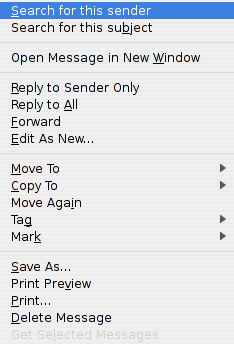 Search for Sender - If you're like me, you like to group like items together in your inbox. With this extension, you can group emails from the same sender as quickly as a right click. Really, it's just a shortcut that places the sender email up into the search box and searches for you. The nice part is, with this extension, you don't have to type it. Quick, easy, and simple. This has quickly become an extension that I cannot live without.
 SyncMab - SyncMab is an extension similar to foxmarks for Firefox. With foxmarks, you keep all your bookmarks on a central server of your choosing so that your bookmarks are the same across all computers you use that have Firefox installed. This is perfect for me since I have a set of work bookmarks and home bookmarks and like to be able to switch back and forth between them. But what about thunderbird? It doesn't have bookmarks right? Exactly, but it does have contacts in your addressbook! So, you'll be able to save your contacts to a server of your choosing and then on another computer with thunderbird you can synchronize your contacts by downloading that file using SyncMab. It's brilliant and allows you to always have the same contacts across operating systems, across computers, and even to maintain multiple addressbooks.
Display Quota - This extension will display a small graphic in Thunderbird that tells you how much space you have left in your IMAP mail account and can warn you when you get close to filling up. This might not be too useful for those of you that use IMAP with huge quotas (gmail) but for others, it may be. I have heard that some users do not like the popup that displays for warning on this extension. For those users, Thunderbird has a built in function you can enable:
Open your configuration editor in Thunderbird and find the following keys:
1. mail.quota.mainwindow_threshold.show - % when quota should show up
2. mail.quota.mainwindow_threshold.warning - % when quota becomes yellow
3. mail.quota.mainwindow_threshold.critical - % when quota becomes red
Thanks to goddess-gate.com for information on how to do this.
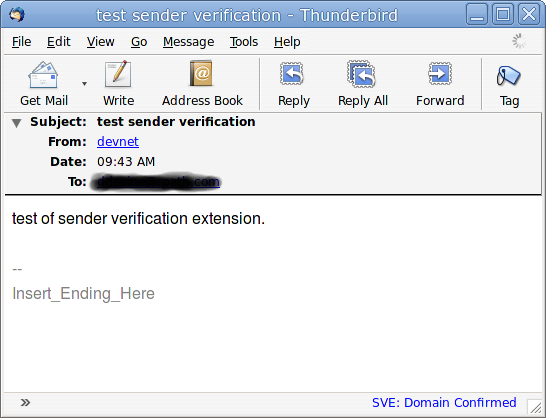 Sender Verification - With the sender verification extension...you can verify that the email that has been sent actually came from the sender. This extension goes out and checks the domain in the FROM field and makes sure that the email originated from this address.
Does it work 100% of the time? No. But for a majority of emails, this extension will make sure that someone hasn't spoofed an email address in your addressbook to bypass your spam filters. The extension uses Sender Policy Framework (SPF) and DNS-based reputation lists to make it's decision and report back to you.
I opened up the preferences for this extension and made sure to toggle "Show verification results in statusbar" so that on the bottom of every email, SVE results display. This even works for previewing mail messages in the preview pane. You can also set individual white lists of domains not to check.
In all, quite a handy anti-phishing extension to make Thunderbird just a bit more secure.
What Obscure Extensions Do You Use?
What obscure extensions do you use to customize your inbox? How do youe extend thunderbird to do your bidding? How does it help you take charge of an unruly inbox? Please share your comments with us here and let us know the steps you've taken to rule over your emails.
24 Ways to Get a customer and Keep a customer
Editor's Note: It's interesting how many ways etailers drop the ball when it comes to customer service. With so much focus on search traffic (front end), it seems webmasters are ignoring their back end responsibilities. Know some effective techniques for better customer satisfaction? Let us know in the comments section.
Sort of anticlimactic, isn't it? The good news is there's a lot of opportunity satisfying customers, even making them very, very happy.
But first, more bad news. Three-quarters of online shoppers surveyed said website content is insufficient to complete research or purchase a product online always, most, or some of the time. Nearly 80 percent rarely or never purchase a product without complete information, and 72 percent will take off to a competitor that does supply that information.
It seems that consumers really want to buy online, but retailers aren't making it easy for them. Sometimes, it seems like retailers go out of their way to lose customers.
My recent search for information about a Polaroid camera comes to mind. In that experience, Polaroid didn't have top ranking for its own product (not even in the top ten), and didn't have sponsored search ads targeting very product specific keywords. The retailers who seemed to pick up Polaroid's slack in the paid results—big names like Circuit City, Target, and Wal-Mart—failed to offer a relevant landing page. When I did find product reviews or pages, the information I wanted (price and specs, mainly) were either garbled by nonsensical rhetoric or was nonexistent.
If researching for myself and not for an article, I would have long before that said, "Screw it. I'll just go to the store myself." All of them lost a potential online customer.
Problems like these aren't uncommon. In fact, it seems many sites are severely lacking in the customer service department. If customers don't prefer online shopping to brick-and-mortar shopping, it's because retail sites haven't done enough to make the online shopping experience a good one.
Ready for more bad news? Here are ways many sites have failed to serve their customers:
- Only 37 percent offer multiple images views of products.
- Only 33 percent offer customer reviews.
- 62 percent have difficult to read fonts.
- Only 14 percent allow customers to change the font.
- Only 43 percent offer free shipping.
- Almost two-thirds do not offer in-stock information on the product page.
- While just over half of online retailers have physical stores, only 10 percent offer in-store pickup.
- 58 percent do not offer shipping costs early in the checkout process. One third have checkout processes with more than 4 steps.
- Only 58 percent correctly answer an e-mail question within 24 hours.
- Around 80 percent don't seem to get that more ways to pay means more ways to buy. 20 percent offer pay-by-check, 10 percent offer Google Checkout, 20 percetn accept PayPal and 18 percent offer Bill Me Later.
Monday, June 30, 2008
Facebook, MySpace Still Fighting For Ad Markets
Competition apparently far from over
Not too long ago, it was discovered that Facebook had become more popular than MySpace on a global level. Only popularity by itself has little to do with profitability, and stats show Facebook has a ways to go in major ad markets.
Whether success in major ad markets leads to profitability is another issue, of course - News Corp. isn't getting rich off MySpace's performance. Nonetheless, as noted by Andrew Chen, MySpace remains on top in the U.S., where the most money is spent on advertising.MySpace is also ahead in Japan, Germany, and Brazil (the third, sixth, and ninth biggest ad markets, respectively). Facebook has a hold on the U.K., France, China, Canada, South Korea, and India.
If winner-takes-all rules applied in each country, MySpace would still be looking pretty good. But things aren't so clear-cut in real life (look up the recent American Facebook-Visa announcement), and Justin Smith points out, "Facebook is demonstrating that social networks can gain ground against an incumbent in meaningful markets after all."
Maybe Facebook's impending move is a sign that it's even solving the profitability problem.
Local Search Engine Optimization - Revisited
Some time ago, Google introduced a "geographic box" at the top of its search results. This is tied in to its mapping feature, and, when it was first introduced, the engine would display three results at the top of its search results whenever somebody entered a geographic modifier into the search box ("Atlanta widgets," for example). The Google algorithm then has the intelligence to determine whether the query calls for results that are primarily local in scope.
Since that initial trial, Google has obviously found that its users appreciate the feature. The engine now displays ten local search results at the top of the listings for certain queries, provided that they have a geographic modifier attached. For example, if you type in "Atlanta gyms" in Google, you will see ten results alongside a map that shows the location of ten gyms in Atlanta.
It should be noted that you will not see local search results for all queries that contain a local modifier. In certain instances, it almost seems as if Google somehow "knows" when a geographic modifier really means that you only offer services in a particular area. Yeah, those guys are pretty good.
There are many resources on the Internet to turn to if you are looking for local search engine optimization for your regional website. However, many companies have client bases that cater primarily to a national or international field. Can they benefit from local search?
Yes, they can - in two ways (with a caveat for the first).
First, many customers prefer to deal with people that are local, even if the business is national, or even global. A businessperson that is looking for, say, marketing consulting, may be inclined to work with someone with an address in close proximity found through local search. It just feels more comfortable - if something goes wrong, he or she can request a meeting, rather than calling an 800 number.
Here's the caveat - you may not want people showing up at your doorstep. Some companies invite people to show up at the headquarters and voice concerns or sing praises, but others would prefer to keep things at a distance. This is not a value judgment by any means. With many companies that deal with thousands, or even millions, of customers, it would be impossible to service every complaint with a human smile.
The second way, which seems more customer friendly (but actually isn't), applies when a large company has many locations. This doesn't mean that your company has "walk-in" locations that are open to the public. If you have locations in many cities, each serving a different function, you can still benefit from local search engine optimization.
Say, for example, you are headquartered in Toledo. You have distribution centers in several cities across the United States. Each of your physical locations is eligible to show up in local search results on Google, provided that you supply the engine with the proper information.
Of course, as mentioned earlier, not all searches with regional modifiers attached will bring up regional results. But based on recent happenings, it's a good idea to make your regional presence known and consider the effects of local search engine optimization. After the years of talk about it, local search might finally turn out to be something that most companies can take advantage of.
About the Author: Scott Buresh is the CEO of Medium Blue, which was named the number one organic search engine optimization company in the world in 2006 and 2007 by PromotionWorld. Scott has contributed content to many publications including "The Complete Guide to Google Advertising (Atlantic, 2008) and Building Your Business with Google For Dummies" (Wiley, 2004).
Using Social Media To Drive Traffic
SMO As Guerrilla Marketing
The nature of Social Media Optimization is such that it could be considered form of guerrilla marketing. Website owners and blog owners have the choice of either investing money or their own skills and time in order to generate traffic from social sites. As long as your efforts are directed appropriately, the more work you put in the more reward you will reap.
SMO As A Link Building Technique
Social optimization also has a happy side effect - it helps to build your link profile so you will usually gain search engine traffic in the long term. Becoming a part of an online community is essential to your social optimization and this, in turn, will naturally provide links to your website. The links will usually be from relevant pages based on a similar topic to that of your own page. The more popular social sites are also given a lot of weight by certain search engines.
Optimize Your Existing Site
Create genuinely interesting, intriguing, or informative pages. Includes images, links, video, and collaborative tools so that visitors really get involved when they do visit your site. SMO is basically digital word-of-mouth and if your website doesn't offer some kind of appealing experience to your visitors, then it simply won't attract the positive word-of-mouth that you want.
Add new pages, if necessary, so that you can include more information. However, don't just add pages for the sake of it - ensure that each page really does have something unique to offer. A website still needs to be well structured.
Get A Blog
Add a blog. Every website has potential blog posts in it so find yours and start blogging regularly. Blog posts tend to attract links from other blog posts and those in turn will spread the word of your website. The more popular your blog becomes, the more value it is perceived to offer and the more visitors you will continue to get.
Be active in those blogs that are within your industry and use your link where permitted and relevant. Don't spam because that will lose you more friends than it will make but if you offer relevant information and a forum or blog allows you to link to it, then offer an insightful comment and provide a link.
Be Active
Being active is a vital part to your whole SMO campaign. Simply registering with social bookmarking sites and content sharing sites is not enough. You need to be involved, post regularly, and generally become a part of the community. If you don't have the time or the inclination to do this then find somebody else to do it instead.
Some Social Sites To Join
You really do reap what you sow in terms of SMO. Determine the sites that are most suitable to your website, join them, and become an active member. Choose some broad topic sites as well as some that are specific to those interested in the industry in which you operate or topic that you cover. Look at social news submission sites, content sharing sites, bookmarking, and networking sites and try to get a broad coverage of all of them. Here are just a few of the sites you should seriously consider using:
Social News/Media Sharing Websites
* Reddit - Reddit is a very popular social news website that boasts a lot of subscribers and covers a wide range of topics.* Digg - Initially, Digg was reserved to technology and related topics but is now a broad topic news site that again has a lot of subscribers and regular readers.* Newsvine - Not as popular as the two above but offering a slightly more formal tone to its content. Again, a good range of topics are covered.
Social Networking Sites
* MySpace - It may be largely riddled with spam but there are still too many genuine users for you to ignore MySpace. You don't have to be an unsigned band to take advantage either.* Facebook - Has caused quite a stir and offers users the chance to create and distribute their own applications as well as content. Another very popular site. * LinkedIn - LinkedIn is a social networking site dedicated to professionals and businesses. It can really help to build a huge network of partners, customers, and other useful contacts in a business network.
Social Bookmarking Websites
* del.icio.us - Register, store bookmarks that you find useful, and include a bookmark to your own website and use a public profile.* Stumble Upon - Same again. Alternatively you can add a Stumble icon to each of your pages, blog posts, and other media and let your readers do the walking for you.
Buttons For Your Pages
Many social websites offer a button that your readers or visitors can use to automatically add a page. Bookmarking and content sharing sites, in particular, have these buttons and if you've ever read a website or an article site then you will have seen the Digg This and Stumble buttons at the bottom of each entry. Users registered with these sites can click the button and quickly add your page. The most popular websites are usually displayed on the high traffic home pages delivering yet more visitors to your site.
Offering Quality
The Social Internet has opened up a whole new avenue for promoting your business, but it needs to be done properly and carefully. Simply tagging, bookmarking, and sharing every page you have regardless of its quality will not bring you the desired results. You may find that it does you more harm than good in the long run.
About the Author: WebWiseWords is a web content writer offering appealing and professional web content. Whether you are looking to implement an SEO or SMO campaign, or you want to improve your visitor's experience while on your website WebWiseWords can create the content you need.
Determining How Long Your Traffic Stays
It is always good to check the number of visitors coming to your site and how long they have stayed. How do you check this? You will check this by your log files. This is done by your c-panel or a similar place depending on what your host has set up for you. Here you can view the different stats about your website.
They will show you:
* Monthly stats-how many visitors came to your site during one month. These will be divided into unique and general (repeat visitors).
* Weekly stats- how many visitors came in 1 week, again they will be divided into unique and general
* Daily stats
* Hourly stats
Most visited pages: These let you know how many visitors have come to certain pages during 1 month. This is where it gets interesting, as you will be able to tell which pages are attracting the most visitors.
The amount of time visitors have spent on your website: This is a good estimate of the quality of your site. Obviously the longer your visitors stay the more chances there are of them buying.
Once you know which pages are attracting visitors you can then work on getting all your pages sticky and compel surfers to visit them.
Google also tracks how long visitors are spending at your site. Again it is a quality check as far as they are concerned. When Googlebots bring information back to the Database about a website being visited and people are staying longer, they can naturally assume the standard of that website is high.
High standard and quality means Google customers (your visitors) are being serviced well and that makes Google happy. This will earn you a higher Page Rank.
Encourage a longer stay:
So we can naturally assume that the longer your visitors stay the better it is. Now how to encourage them to stay? Have you ever read a book that you just could not put down? Well you website must have that same effect on your visitors. They will not want to leave until they have devoured every word of your pre selling content. They should be in the mood to either sign up for your free newsletter and become your leads or go on to your sales page and buy your products or services.
Making them stay: Make your site an irresistible, sticky website that draws your visitor in and compels them to stay. Here are some ways:
* Interesting informative content* Stories, anecdotes, and news about your industry
* Quizzes relating to your industry-the answers will be found on one of your important pages
* Good user friendly navigation
* Humorous jokes, quotes and stories related to your industry-these are often shared among friends and associates (viral marketing).
So try some of these ways to make your visitor want to stay at your site. Use all the resources you have and write that good informative content to pre sell your visitors. Provide them good products and services and see your visitors convert to your loyal customers because you have made your website irresistible to them.
About the Author: Frank Herald. A webmaster and internet marketing specialist Search Engine Optimization Australia.
Video Marketing for Small Businesses
You might be asking why you should consider it at all when your current advertising is working just fine. Aside from the fact that adding another strategy to your marketing plan is a good idea, videos are very personal. Who better to discuss your service or product than you? It brings a familiarity to you and your company, which allows the prospect to feel like they already know you. If the message is directed to your current customer base, seeing and hearing you gives the feeling that you are presenting your message directly to them.
There are professional videos and way too often, not so professional videos. Most of us cringe when we hear a car salesman screaming about a wonderful deal waiting for you if you'll come down RIGHT NOW! Or the windows and siding guy who squawks about the fantastic savings if you call within the next 30 minutes (but the ad runs all day long). These are stereotypes of TV advertising available for the small business owner. But it doesn't have to be that way!
Cable TV ads can be very cost effective because you can be specific where your ad dollars will be spent. The cable company has demographic statistics so you can learn what programs are viewed most frequently by your target market then select where (as specific as the zip codes) and when you want your ads to run. The variety of shows cable companies have in their lineup provides a fantastic choice for the advertiser. In addition, they can also slot your ad in during the Big 3 networks' shows as well.
Videos aren't only just for cable TV. There are many companies that create videos which can be linked to websites, newsletters, social networking sites and email signature lines. They serve many purposes from advertising to introducing a new product or service to just send a keeping-in-touch message to current clients. These videos are also used for on-line training and even instructions to learn how to use a new networking website (http://www.OneDegreeConnected.com). Some are scripted, while others are produced to simulate a talk show format. Compare cost as well as professionalism. This form of advertising can be extremely high-quality or can be an embarrassment to your company's image. Get referrals! View some of the finished productions of each company you are considering before signing any contract.
You can even create your own video while sitting in your office. Do you have a video camera or a video cam connected to your computer? You're all set to create your own video stream to be placed in emails or on your website. A word of caution is to make sure it's not too long. Keep it less than 90 seconds and you'll usually keep the viewer's interest.
Video has created the opportunity for business owners to star in their own commercials. Consider the scenarios mentioned earlier of what video advertising could - but shouldn't - be. Luckily, these are the exception and not the rule; most ads are professional from writing the ad copy to the production. Of course, it's important to remember that the familiar saying "junk in, junk out" holds true for video more than any other media. You're dealing with three methods of presenting the message: content, visual and audio.
Therefore, if you choose to take part in your videos, it's best to receive some coaching prior to production. Accent On Business (http://www.accentonbusiness.net), known throughout the United States, will help you with voice and presentation skills. Public speakers, politicians, sports figures, CEOs and others consult with a professional voice and speech coach; so should you. You will have total control over what needs to be said, but they will help you say it with the professionalism that will provide the image you want to present.
New technology has made video marketing very affordable even for the smallest budget. There are a variety of opportunities and one will certainly fit your budget. Consider video in your next marketing plan. You'll find a new media that will present your company with a fresh message and make it personal.
About the Author: Cindy Hartman invites you to view her marketing video at http://www.HartmanInventory.com to discover why you need a personal property inventory. Also learn about a complete business startup package for a business or home inventory service. Let the Hartman's help you start and grow your own personal property inventory service.
